(LinkedIn)
Are you a team player? Do you have a proven track record as a problem solver in a fast-paced, results-oriented environment? If so, you might want to think of better ways to describe yourself the next time you’re applying for a new job.
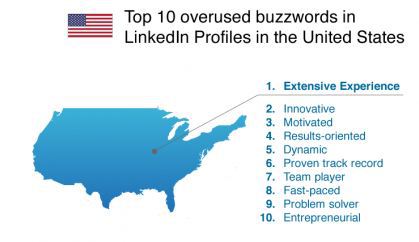
The folks at business-minded social networking site LinkedIn analyzed their analytics for their 85 million registered users and came up with its list of the Top 10 Overused Buzzwords for 2010:
1. Extensive experience
2. Innovative
3. Motivated
4. Results-oriented
5. Dynamic
6. Proven track record
7. Team player
8. Fast-paced
9. Problem solver
10. Entrepreneurial
Of course, there are those rare situations where a cliche like “motivated” would be a step up from “on the run from federal marshals,” and “team player” is generally always better than “Pittsburgh Pirate.”
Let’s hear your suggestions for how to avoid using these tired terms and phrases.
Did you use one of these 10 most overused buzzwords in your LinkedIn profile this year? [LinkedIn Blog]


…and “team player” is generally always better than “Pittsburgh Pirate.”
Well Played, Chris.
Yeah –
And, as of today, Cliff Lee is definitely a “team player” in Chris’ eyes.
hell yeah, wooooooo phillies
/had too much caffeine today
I prefer to use “Extenz experience”. It landed me that “Survivor” gig.
This is why I hate resumes and think they are worthless. They’re just a load of BS everyone uses to embellish their accomplishments, and they always end up being totally repetitive.
What would you want to replace resumes? I mean, society used to judge a person’s qualifications based on race and lineage – let’s not go back to that.
Most online job applications (that I’ve looked at) seem to have a list of checkboxes to indicate what skills you (claim to) posses. I’ve actually found that they look at that first to filter candidates they might want to interview, then look at the resume to make sure you didn’t stupidly contradict yourself on the checkboxes as well as use it for a sample of your writing skills (should it be applicable in any way for your job).
Many jobs aren’t looking for skillsets as much as aptitude. With the right aptitudes, you can be trained on any skillset.
People are always going to embellish their accomplishments for the sake of getting a job. The same way a salesman might stretch the truth a little (or a lot in some cases) to make a sale. Actually, I’d call that being “results-oriented.”
That’s why just about every major job I’ve applied for would send me to their hiring website. In it would be skill boxes that needed to be ticked off on top of a place to upload your resume & cover letter. They would do this even after I spoke to a live human and got an interview. It’s one more way to be able to look over your skill set vs. the job description.
Side note: The job description is almost as worthless as a resume. Very few places keep them current as to what the job completely entails. They seem to error on the side of caution by filling them with every possible thing you might do but will never do in reality. And they seem to forget to put in the some of the mundane stuff that makes up 30% of your hidden workload.
Yeah, I think all a resume should be is a list of verifiable jobs. Let the interview (and, maybe, conversation with my previous boss, if appropriate, and with my references) dictate whether or not I actually get hired.
“Yeah, I think all a resume should be is a list of verifiable jobs. Let the interview (and, maybe, conversation with my previous boss, if appropriate, and with my references) dictate whether or not I actually get hired.”
Yeah, that’s not useful at all for someone screening dozens of applications for each job.
These words are terrible to use on resumes because they get jammed in wherever possible. And, of course, many of them aren’t terms that people use in real life. Terms like “Results-oriented” or “Team Player” are especially useless, because it implies there is a probability of “Results-who-gives-a-shit” sitting out there on a resume.
You can say you’re innovative and not have it come off as phony, as long as it isn’t.
They are only repetitive BS when people write them that way, using words such as those listed above. If you write a good resume it should make you stand out from all that.
Your resume is the most valuable piece of paper in your life. It can make the difference of several thousand dollars a year if done right. It is an art form in and of itself, where the point is to make it rock without all the fluffy words.
That’s why YOUR resume is worthless. Mine is a reflection of my accomplishments, with very little embellishment.
Those of you who embellish your accomplishments are making those of us who accurately describe our accomplishments look bad.
In my last job, I was hired part time with another person, also part time. When it became clear that she embellished and I described accurately, she was let go and I was given her hours, resulting in a full time gig.
There’s nothing wrong with trying for a position that will be a stretch. There is everything wrong with claiming skills and experience you don’t actually have.
It’s not bragging if it’s the truth. It’s lying if it’s not. And your employer WILL find out.
I am a spastic (#5) group participant (#7) who is self-encouraging (#3) and focused on output (#4). I am an original thinker (#2) who has had a lot of work (#1), and a long resume to back that up (#6) (see attachment). At my last job, I finished my work four hours ahead of deadline (#8) while running on the treadmill, which also fulfilled my work-mandated exercise program. I think this is not only ingenious, it also allowed me time to take a nap afterward (#9, #10).
Thank you for your time!
Pecan Pi, you are HIRED!!!
Nobel Prize Winning (fill in the blank)
What I hate about buzzwords is that many of them originally had original, specific meanings before they devolved. The tendency of idiots to use words they don’t understand eventually robs real terminology of its utility, because then people think that an intelligent person who uses them is just another idiot spewing buzzwords.
Yeah! A complete paradigm shift!
Your reply is pure Synergy!
that reply was outside the box, i like it
It was in his wheelhouse.
It made it POP.
Amen brother! I’m back in the resume-writing pool and I don’t know what to write that doesn’t just sound like a string of meaningless buzzwords while still stressing my experience and qualifications.
As I told my meme-loving 11-year-old. “When everything is epic, nothing is epic.”
This is why I let my smoldering gaze do the talking during my job interviews.
Dang, and here I’ve always aimed for “cheerful and earnest” …
While they’re overused, the bulk of corporate America’s resume scanning systems in hiring databases scan for the same words. Lose-lose.
Not to mention it’s always about who you know.
Actually, we don’t ever look for those words. As a recruiter, I look for “sales”, “quota”, “account executive”, names of my competitors and other terms that are more specific. The buzzwords aren’t worth diddly in that situation.
Exactly. My resume lists some very specific certifications I have, and I make sure to both spell out the name of the certification and include the commonly-used abbreviation for each one. THAT is what recruiters in my field are searching for.
We do look for people who have some or all of those qualities, but we would never scan the resume for those words. For example, someone who is innovative will list examples of innovative things they’ve done. I care about that. But I don’t care one way or the other if they’ve put that they’re an “innovative problem solver.” That’s just fluff that everybody has on their resume, and it gets ignored.
Good point. These guys always fall apart in the interview, too. “Okay, name one problem that you solved in an innovative way.” Response, “Well, I, well…”
Also, I’m someone who thinks outside the box. See that box over there that all your other candidates are stuck inside? Well I’m over here. Outside it. Thinking.
If you’re an actor at an audition and the assignment is to personify Shrodinger’s cat, are you still “thinking outside the box”?
It depends…am I the living cat or the dead cat?
No one (including you) know until the box is opened.
Does the box have air holes?
Both, think Nic Cage in Face Off.
But if I use Nic Cage as my inspiration, I’ll never get that acting job!
Step 1: Cut a hole in the box
Step 2: ….
May I just take a moment to throw out the Ask A Manager blog as a link? http://www.askamanager.org/ It is a really great website with a lot of resources for job hunters and it’s funny to boot. I’m fortunate in that I have a job, but I still like reading her insights and some of the stories that are posted.
Without “problem solver” on my resume, I never would have landed that job down at the Rubik’s factory.
Extensive skill set = Educationally Diversified
Problem Solver = I AM Smarter than a fith grader
Team Player = Bi-Curious
Innovative = Created a list of over used terms
Proven track record = Always at the track
Motivated = probationary
Fast-paced=does coke in the bathroom
Results-oriented = Say hello to my leetle friend.
Entrepreneurial = Hawks daughter’s Girl Scout Cookies at office.
I will continue to use the same buzzwords that businesses add to job descriptions when seeking candidates.
Namely, the 10 listed above.
In other words, I wish businesses would stop using these, too.
I was going to mention this. Candidates put these buzzwords in their resumes because job descriptions ask for them. If a candidate wants to get HR’s attention, their resume must closely match the job req.
“Candidates put these buzzwords in their resumes because job descriptions ask for them.”
They want employees to BE them, not claim to be them. Anyway, they’re soft skills and have little place on the resume, they are to be determined during the interview.
I just can’t keep up with all the buzzwords. So “proactive” and “synergy” are out? I guess I need to delete “Synergy – I haz it” from my resume.
Isn’t “(I’m) unemployed” usually death for an applicant?
Not always — sometimes it means you might just be desperate enough to come to work here.
Or, that you are available right away…no waiting.
I did that two jobs ago.
I was unemployed for about two months, and told each interviewer that I could start immediately. In a couple of the cases, I even said, “If you want me here tomorrow, I’ll be here tomorrow.” One of the interviewers replied with “Be here tomorrow at 8″ and so I actually started that job on a Friday.
Not these days. Interviewers are used to running into the unemployed in this economy. I was unemployed for 8 months and was picked up by a major corporation in my industry… even though I had been out for six months, they offered me more than I was making at the old company.
But “groin-grabbingly” is still a perfectly cromulent adjective, yes?
Actually, it’s an adverb.
Do I get the final say?
So I guess this type of paragraph is out now…………………………………………..
I guess we’ll need to form a committee of team players with extensive experience to investigate possible innovative synergies for tackling this dynamic issue. This committee needs to have a proven track record, be motivated and entrepreneurial. This is going to be a fast-paced problem solver sort of thing. I am very results-oriented.
I forgot to mention, a friend of mine came up with this. It had to be posted. Thanks Dan
that made my head hurt.
Of course, Barney’s Video Resume is all anyone ever needs as a reference of how it’s done.
Barney Stinson! That guy’s Awesome!!
I am a team player. I am just not on YOUR team.
This crap is overused because it works. I can’t tell you how many common sense performance evaluations I’ve submitted only for my boss to have replaced every third word with one of these terms while giving me a long lecture on how I need to improve my writing to incorporate more of this junk.
Too true. Ever sit around a bunch of MBAs? They actually do chat in buzz words and their PowerPoint presentations drip with this B.S. that has no meaning. What’s fun to do is to ask them a straight question as to how this “Problem Solving Synergy” or whatever buzz word they’re using is suppose to work in the real world and to give some examples. If they don’t stammer and look like a deer caught in headlights, then they simply use even more buzz words to wrap themselves in some magical blanket of impenetrable illogic. Their hope is that you’ll think they’re smart.
The saddest truth is that if you’re not awash in this B.S. yourself and know how to use it, you’re at a disadvantage in dealing with bankers and venture capitalists. I’ve seen more crap get funded when a good idea doesn’t,.
Sadly, I agree as well. I’ve worked for a company that religiously used these words. I, too, have had managers tell me that in my reports and self-reviews to rewrite them and include more words like this. It made my soul hurt. My degree is in creative writing and it killed me to do it, but I did it. When they started telling me that I had to outright lie to customers to cover upper management’s worthless asses, I had to quit.
I know things and would like to work. Please I can haz your jobs? Thanks.
Somehow that’s not working.
I’ve only used #1 before, mostly because nothing works as well with crappy retail experience. Sighs.
Resume writing for auto sort isn’t that hard. Read all the buzzwords in the job posting. Make sure to work as many as those in to the resume you send as possible.
Self perpetuating job security for those who sell this stuff? Although I guess those words are better than rambling on and on.
I only have the first offending buzzword on my resume, because my experience in this field is actually extensive. I ought to think of a reasonable substitute, though.
Most of the job descriptions I see use the following: client-facing, cutting-edge, boutique, hip, fashion-forward, downtown, niche, keep everyone on track, go-getter, great attitude and energy, multitask, proactive, hit the ground running, detail-oriented, and a passion for exclamation points!!!!
Sadly, I’ve found that so many managers who insist on using these words to screen for potential candidates seem unable to hire people capable of actually writing a decent client email (am I the only one who has noticed this in the past several years?), and believe that simply using buzzwords constitutes effective communication. Whenever clients do meet me in the flesh, they assume I’m 70 years old based on my digital correspondence.
I think that “extensive experience in ___________” is different from just “extensive experience”.
“I think that “extensive experience in ___________” is different from just “extensive experience”.”
Not as much as you think. “Extensive” is tooting your own horn, nobody cares what you think extensive is. State what your experience is.
Actually, instead of extensive experience, I would recommend something like ” ten years experience in creative ad writing, and client presentations”. THEN list some of those clients. Or if it were the computer field ” Ten years in Microsoft systems with implementation of Windows 7 upgrade for 600 employees”
As a hiring manager, I want numbers and details. Give me your accomplishments not your attributes. Most hiring managers really don’t care about attributes because my assumptions are if you perform for company A, and have solid accomplishments, then you can be molded into what I need. I actually look for this in resumes from those fresh out of college as well. What is your GPA? Some don’t think it is important, but it IS the scorecard used. Yes, extra curriculars matter, but I want to see if I set you with a goal, can you meet it. If your goal is to skate by with mediocrity, you likely will have a GPA of 2.0.
I am sure plenty of people will jump on me about the last thing, but all the examples people give me of people who did poorly in school and were successful are usually not EMPLOYEES. They start their own company. Bill Gates would not be a good employee, though he did well starting his own company.
Gotcha. The offending phrase is in the objective of the resume, but I definitely give plenty of details throughout. I specialize in short-term projects, so those who might be considering whether to bring me in aren’t interested in my gradual malleability, but rather my ability to adapt quickly to the immediate project. I’m long out of college so I’d question my GPA’s relevance to my current career, especially given my particular major (suffice to say, slacking was impossible if you had any hope of simply graduating in my program).
You bring up an interesting point about GPA and mediocrity; last night’s Nightline profiled a man who had written student papers for years, and it was sadly not surprising so many students are submitting others’ work as their own. I understand that GPA might be relevant to recent graduates in calculating their risk or potential, but who knows if they really have basic skills? I get the impression that some of the aforementioned former coworkers unable to craft an email were probably among the many cheaters.
One recent example of hiring ” the latest and greatest ” is Best Buy who in 2009 wanted some management positions filled with ‘tweeters’ with alot of friends.
http://blogs.discovermagazine.com/discoblog/2009/07/14/want-a-job-at-best-buy-better-have-250-twitter-followers/
Over a year in their new jobs and that worked out really ‘ w e l l ‘
http://blogs.barrons.com/techtraderdaily/2010/12/14/best-buy-plunges-on-weak-tv-sales-cuts-forecast/?mod=yahoobarrons
Best Buy sales and stock tank. The big duh here besides online viewing is that the tv digital conversion or impending digital conversion drove tv sales just about every where. But these fools thought it was a true fad or something they were doing. HA!
So much for twits that can tweet. So much for the latest and greatest or the top 40 of resume vocabulary.
I use none of these words. My group-focused synergies are aligned with the macromanaging symbiosis of circular driven companies.
Interesting. I find that my can-do attitude as the go-getter than I am makes HR interviewers stop and take note.
For most jobs:
The resume: an idiot screener
The interview: an idiot screener
The background check: an idiot screener
If you’re not naturally good with people and/or have the same qualifications as other applicants, you basically have to get lucky and get an interviewer that likes you.
Actually being a Pittsburgh Pirate is usually a pretty effective way of getting another job quickly. At least if you are any good.
The Pirates are the best team in Quadruple-A!
If you’re on the Pirates and any good, you’ll be on another team at the end of July, when the trading deadline comes around.
since i tend to work in customer service jobs there are only three words that need to go on my resume “Walt Disney World”
really, disney theme parks carry that much weight in CS circles?
so far, yes. especially outside of florida. but my experience there was also as a guest services person which carries more weight.
my first job interview after i left disney, i completed the interview and got a call on my cell phone before i made it to my car- the assistant manager had interviewed me, his boss wanted to interview me right away and they offered me the job within an hour.
the job i have now, i’m one of the very few non college graduates.
it’s the ability to keep it together when someone is irate and verbally abusive … a valuable customer service skill
Wow… I think I have 3 of those in my opening sentence alone.
I now have a new objective line for my resume and my linked profile. Thank you consumerist!
Objective: To work at a fast-paced entrepreneurial companly where I can leverage my extensive experience as an innovative, motivated, results-oriented, dynamic team player with a proven track record as a problem solver.
[runs to update resume']
I’ve been told that the perfect resume echoes the qualities the employer is looking for. So, when they want a team-player, I’m a team-player. If they want creative problem solver, I’m a creative problem solver.
In my experience, these terms show up in resumes because those are the terms the employers are looking for.
Did I miss something? Is the job description just one big trick question?
“Is the job description just one big trick question?”
Now that you’ve discovered our secret, you must realize that we can’t let you leave this interview alive. So who else knows that you are here right now?
A resume should be set up more as a list of accomplishments. “Grew sales 60% in 2010″ , “Trained 6 new sales associates who have managed 12% growth”,” Won company Chairmans Club award for top performance” , “reduced department costs by 7%” “completed level 3 Power point certification”. Stress accomplishments, not attributes. I have plenty of people who work for me, who I would call non-team players. I hire them because they perform. If somebody is TRULY results oriented, then show me your results. Otherwise you are words oriented.
I guess I should never start a presentation on problem solving like this…
http://skreened.com/mongoware/stop-collaborate-and-listen
or this
http://skreened.com/mongoware/problem-yo-i-ll-solve-it
With translations:
1. Extensive experience
2. Innovative = Doesn’t pay attention during training
3. Motivated = 6 months behind on rent and about to get evicted
4. Results-oriented = Don’t watch me work. You don’t want to see how I get there.
5. Dynamic = Did I mention my last workplace burned down? No? My bad.
6. Proven track record = Good luck calling for references. They’re all dead or moved on.
7. Team player = I don’t do anything until someone tells me.
8. Fast-paced = I sneak out 15 minutes before close. I have things to do, man!
9. Problem solver = I might as well because problems seem to follow me!
10. Entrepreneurial = Better not trust me with the till. Or the stocks. Or anything else for that matter.
Innovative-didn’t pay attention during training LOL
How about Results Oriented- I do what EVER it takes. So what if the ethics policy gets ignored. Legal trouble-pfffft,not if I don’t get caught. Who cares if I bend a few rules, fracture a few laws or just flat out lie & cheat.
I tried hard to rewrite my resume as a skills resume using action verbs instead of just listing job duties, but it’s really hard to find accomplishments when all you do is answer the phone.
“Dynamic, fast-paced results-oriented switchboard operator with a proven track record in innovative customer service and extensive experience problem-solving callers’ inquiries and transferring their impatient asses to disinterested entrepreneurial team players’ voice mail.”
There, did I get them all?
The one that drives me crazy the most is detail-orientated. I mean what does this actually mean? I realize that it probably means someone who pays attention to detail, but isn’t that everyone?? Some examples: when I dust I make sure I am dusting every speck of dust. When I organize my music library, if there is one title tag or artist that that is wrong I must fix it or else it will drive me insane until it is fixed. There.
When I applied for your job I made sure to note the buzzwords (every single one) used in your job description then I made sure I used them somewhere (again, all of them) in my job application or resume. This is also a good example of being detail-orientated (sarcasm). Most job hunting advice sites or general advice on job hunting will tell you to do this and that it makes your application relevant to the job if you do this.
A Thesaurus.
Ok another thing that miffs me about job hunting, I just read an article on this site that said a hiring manager is usually not prepared, likely has a very busy schedule, and wants to get through the interviews as quickly as possible and doesn’t really want to be doing the interview job in the first place. Then I read another article on another site that said the candidate must be prepared and should be very familiar with the company they are interviewing for. However the article on this site said that the interviewer is usually not prepared to answer questions about the company’s background and that they usually don’t care about that. The other website told me to know the company background well and to look up information about how its stocks are doing and other information about the company then you are supposed to ask questions about this at the end of the interview. They were quite adamant about making sure the reader knew how to research the company you are interviewing for and that the interviewee should definitely know this stuff before going into the interview. But if this site says the interviewer doesn’t care about that, which one should I believe???
Are websites just spouting mindless job interview preparation articles to get more page views or comments because obviously there is a conflict of information going around??
If I asked questions about the company at the end of the interview, and the interviewer felt overwhelmed by that or couldn’t respond to the questions because they didn’t have the correct information because they were just thrown into the interview session due to a very busy schedule, then obviously that wouldn’t be a good thing and would mean I probably wouldn’t get the job. I don’t think it could hurt to be prepared, because you could always just hold back the info. However how do you know when you are supposed to ask a question about the company and when not to…
“They were quite adamant about making sure the reader knew how to research the company you are interviewing for and that the interviewee should definitely know this stuff before going into the interview. But if this site says the interviewer doesn’t care about that, which one should I believe???”
Both. You’re supposed to research and prepare. The hiring director doesn’t always have the resources to research before you get interviewed.
I don’t see that the two are mutually exclusive here, you’re the one who needs a job, and who has to prove himself. The interviewer is usually good at his job enough that he doesn’t need to re-study the company.
I mean, you only have to know enough about the company to ask probing questions that show your interest.
They’re overused because HR pundits spent a decade telling people they needed to put buzzwords in their resumes. I’m pretty sure these are the same ones that HR drones put in job listings.
One of the stupidist financial moves I ever made was to hire a “Career Consulting Firm” to help land a better-paying job.
It retrospect, the satisfied clients given as references before I signed up were shrills. The resume they wrote was worse than my existing one – thier version had all ten words/phrases on the first page.
As other posters have already noted, potential employers seem more interested in specific examples of your past performance.
“shrills”
Shills, btw
Given the fact that so many of the job ads I’ve seen over the years also use these buzzwords (“Fast-paced, dynamic company seeks motivated, results-oriented individuals”), this is hardly surprising. Problem-solving team players will of course adjust their resume language to match that of jobs being advertised.
I love resume advice. Most of what we read has some other article contradicting it anyway.
All a resume is good for is getting your foot in the door to talk to a live person. I think it’s the oddball stuff that sets you apart that gets your resume noticed. Putting the same cliches as everyone else just makes you another sheet in the pile.
When I interviewed for my current job, they specifically called out two skills that they don’t see on college grad resumes: COBOL programming and QA experience. Got me the interview, and THEN I told them what a results-oriented, team-playing problem solver I am!
I have extensive experience in telescope deployment.
I just started a new job at the beginning of the week, and I’m pleased to say I did not have any of those buzzwords on my resume.