
Ah, salads. The food of the perpetual dieter. You all know a few fast food salad eater. She’s the girl at your office who eats nothing but salads and yet never seems to lose any weight. He’s the guy who eats a salad because he’s on Atkins, but it doesn’t seem to be working. Why is that?
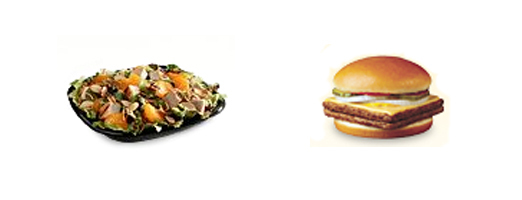
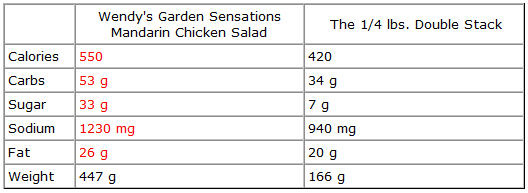
What if we told you that a Wendy’s Garden Sensations Mandarin Chicken Salad had more calories, more fat, more carbs and more sugar than a Double Stack? Would that surprise you? It shouldn’t. The nutritional information is right there on the Internet.
Curious as to how fast food salads compared with fast food sandwiches, we took a look at one sandwich and one salad at 4 different fast food restaurants: Wendy’s, McDonald’s, Taco Bell and Burger King.
We wanted to know if you were really better off eating a salad, or simply getting a burger(or burrito) and skipping the fries and soda.
RULES OF THE GAME:
- • We will choose one salad and one regular sized sandwich (or burrito) from the same fast food joint and compare them.
• We will compare calories, fat, carbs, sodium and sugar.
• We will include the dressing in our total, because eating salad without dressing is nasty.
• We will also compare the weight of the salad vs the burger (or burrito).
• We will use the nutritional information provided by the restaurants.
• We will not evaluate the food’s subjective qualities such as taste, because no one really cares if The Consumerist likes Wendy’s better than McDonald’s or salads better than burgers or burritos better than salads.
• We will operate on the assumption that at least a few people eat fast food salads because the marketing message suggests, although may not explicitly state, that salads are a healthier alternative to fast food sandwiches. We will not assume that everyone eats salads for this reason. Some people like salads and that is OK.
• We will not assume that in order to eat a burger you must eat french fries and a drink, therefore we will not include them in the sandwich total.
• We will not compare a salad to a huge sandwich like a Whopper or a Big Mac, because that’s just silly.
THE PLAYERS:
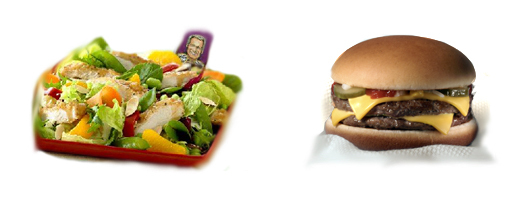
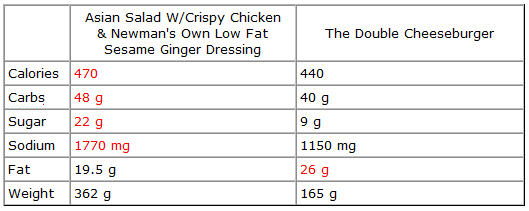
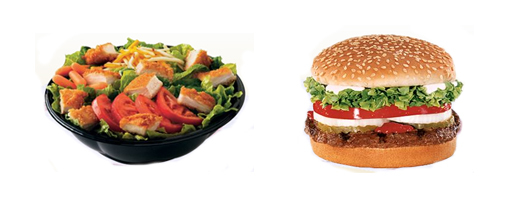
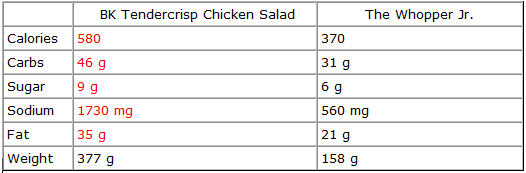
THE CONCLUSION:
The results speak for themselves. We got the idea for this experiment when we went looking for healthy options at fast food restaurants. We noticed something odd. The salads didn’t seem to be a whole lot healthier than some of the regular sized sandwiches. Who knew that eating a full portion of, say, the BK Tendercrisp salad would result in consuming 210 more calories than if you’d simply ordered a Whopper Jr.?
Of course, that could mean that the Whopper Jr. is an excellent diet food. It all depends on how you look at it.
If calories aren’t your biggest concern, the salads also packed quite a hefty helping of sugar and carbs. Since they’re often marketed towards carb-conscious eaters, we were surprised to see the amount of sugar in some of these salads. Wendy’s Garden Sensations Mandarin Chicken Salad has more sugar, yes sugar, than 8 oz. of Coke.
Obviously, portion size was an important factor in the calorie count. These salads are big! We’d recommend eating less than the full portion, but realistically… you’re going to eat all the chicken and cheese and other goodies off the top of the salad and leave the lettuce…
So is a fast food salad a good “diet food”? We’ll leave that up to you. We will say that we never really thought of a Double Cheeseburger as something to eat on a diet, and it weighs in with fewer calories than the Asian Chicken Salad w/Crispy Chicken and Newman’s Own (Low Fat) Sesame Ginger Dressing at McDonald’s. Again, this could just mean that Double Cheeseburgers are a better diet choice that you might think.
We know a lot of people think of a salad as “less” than a meal. Read the nutrition info. In quite a few cases, you might better off just ordering a sandwich… and skipping the fries. —MEGHANN MARCO
(Photo: Meghann Marco)


Like many others I think the whole point of this article is to illustrate that the salad may not always be the most “healthy” choice even though it is marketed as being healthier and sometimes even marketed to the point where they tell you that oh, eating this salad over a burger will magically make you lose weight!
You can find things that are better for you on the fast food menus if you are careful. Subway makes it really easy to choose options that are healthier but even they advertise heavily trying to sell you double meat and double cheese for your sub. In reality you have to choose your options, tell them to forget the cheese and choose a low calorie or calorie free dressing over mayo (I don’t even like mayo so the other dressings are a welcomed choice!), skip the chips, cookies or other extras and get a diet soda or a bottle of water. And yes subway can be just as bad for you as Mcdonalds or Burger king if you order items that have a lot of fat or calories. Going for the “meal deal” usually includes something that is not healthy for you, your better off choosing individual items off the menu.
I do not eat at fast food places as a general rule but sometimes it cannot be avoided, thankfully there is usually a subway around every corner. The trick is to control yourself when in these places, don’t order everything off the menu and don’t let the employees push you into purchasing food that you do not really want.
@mental: Great points. I especially love the EDY’s commercials with the guy going back to get more ice cream because it has 1/2 the fat and he can ‘eat more’. Uhhhhh…..doesn’t going back for more defeat the purpose of eating the lowfat ice cream?
In the spirit of balance, I like McDonald’s cheeseburgers (though I order them plain with ketchup). I like fast-food french fries. Oh, and I like diet soda too (I was put off by the aspartame initially, but after a week or two I got used to it). I very rarely *eat* at the fast food chains, and the thought of the food’s unhealthy qualities does weigh on me when I do, but the food itself can be pretty yummy, which is half the reason people go there.
Those of you who are naturally disgusted by foods with high fructose corn syrup, saturated fat, and cholesterol: be grateful for your disgust.
It’s been said, but yes, check the weight of the food. In the top example from Wendy’s, I’d take the salad in a second since that is almost 200% more food for only 25% more calories.
There are people who freak out at the notion their food has more than X grams of fat, but Calories is what you’re ultimately measuring. Fat and Protein help you stay satiated longer. (Thank you to the old NetHack computer game which taught me the word Satiated at a young age.=)
Fast Food Salads tend to contain more High Fructose Corn Syrup than burgers and burritos (though buns do contain HFCS, as do most mass produced baked goods). HFCS effects the blood sugar levels and the metabolism much differently than any other natural sugars or fats. HFCS is synthetic slurry manufactured from corn syrup altered at a molecular level. Read “Fat Land” by Greg Critser for some great information on the connection between HFCS, it’s release on the market in 1979 and America’s rapidly increasing waistline ever since. 7UP label it product 100% Natural ad yet uses HFCS claiming it is natural because it contains Corn Syrup. Many food advocacy groups are campaigning to change the FDA’s definition of 100% natural because of this.
I am a trained chef and I can tell you nothing you eat at any restaurant is as healthy as what you can make at home from scratch (I don’t mean processed pre-made simply add water foods). That being said there is a connection between poverty and improper diet. The sad reality is that it’s cheaper to purchase products that are full of HFCS and Trans fats than it is to purchase healthful product. Anyone who says otherwise has never tried to buy dinner with 2 dollars in their pocket. I am attacking no one person individually but I have to question if some people’s ideas about the ease of “eating a proper diet” aren’t connected to their middle class entitlement and their ability to access products and services that simply aren’t available to people of a lower means or socially marginalized. Take my neighborhood for instance. I live in what is unquestionably an urban environment: Downtown Oakland. Thousands of people live here and yet here is not a full service grocery store within 3 miles of our home. People without cars have to grocery shop at convenience stores (try shopping healthy there) or eat off the menus at McDonalds and KFC. To refuse to acknowledge the dietary limitations of an area where you can not purchase food to manufacture at home speaks more to your own attitudes about food politics and class warfare than anything else. Marginalized people eat poorly because corporations exploit their poverty by withholding easy access to healthy foods while offering low quality products on every street corner for .50 cents.
Additionally many products have reputations of healthiness but often change their recipes after gaining that reputation (See the Breyer Ice Cream post from a few months ago) I can give you an example from this story: McDonalds’ sells Newman’s Own dressing with salads as a way of brand marketing and brand identifying with a well known and respected product hoping some of that healthful image will rub off on their product. The nutritional information on the Newman’s Own packet is worlds apart from the nutritional information on a store bought bottle. Newman’s Own has changed the recipes adding more sugars (in the form of HFCS) to their product. I am sure they did this for at least two reasons: 1. McDonalds’ has fond that sugary food are more desirable to consumers and asked Newman’s Own to change their recipes to adjust for this desire and 2. HFCS is cheaper and allows for a less expensive product resulting in higher profits. To be honest when I discovered this bait and switch on the part of Newman’s Own 2 years ago I stopped buy their dressings because I really felt they were exploiting their branding to provide a lower quality product.
I’m going to have to go with the majority on this one…articles like this shouldn’t be appearing on The Consumerist, because as many pointed out it is terribly flawed and bordering on one-sided. Using this logic, I could conclude that eating a Kleenex would be healthier than any of these options, since it has less of everything listed.
I come to The Consumerist for interesting, multi-faceted stories that are truthful and pointed. This is not one of them. Please try not to post things like this, it really detracts from the truthiness of the overall site.
Firestarsolo, you don’t think a major corporation producing a product that outwardly appears to made from ingredients the FDA and nutritionists drum into our heads are “nutritious” and “better choices” and than filling those healthful choices with unseen fillers and by-products forever changing these products from healthful to unhealthy makes for interesting multi-faceted story? It’s incredibly interesting to me. I would like to see Consumerist do more with food politics.
I’m not saying the science of this comparison was perfect, but many people are unaware of the significant gulf between what they think they are consuming and what they “are” consuming. I gave a speech on this to a group of 20 college kids 4 months ago and you’d be amazed that most of them really thought they were eating healthier when they purchased a yogurt cup and a salad from Mickey D’s. They think this because McDonalds and by default the government for not legislating guidelines, tell us that yogurt and a salad are healthy food. Geez, look at how many people have commented on this blog that they eat Subway because its better for them. Subway’s not better, it has sold us a line about being better and we as uninformed consumers have bought it hook line and sinker. How many times does the media, the FDA, school health class, etc, tell people to use common sense when purchasing food? A salad seems much more common sense to someone attempting to eat healthfully. The hidden calories, carbs, so on, is a purposeful deceit on the part of McDonald’s, Wendy’s etc. I had thought to point of Consumerist was to point out those deceits? It’s very easy for each of us to say “Of course they are bad for us, it’s fast food!” but not everyone is as skeptical of corporations (naïve bastards) as most Consumerist readers are. Should this website only preach to the choir or should it post stories that might illuminate those not yet fully aware of corporate mis-behavior?
Silly me, I just order off the kids meal if I have to eat fast food.
@Ponygirl: “HFCS is cheaper than sugar.”
Actually, this is no longer absolutely true. Because of the rising demand for ethanol from corn, HFCS is comparable in price to sucrose.
And while I absolutely agree that companies make it cheap and convenient to eat unhealthily, as you say in your first post, I’m not willing to give consumers a free pass like you seem to be saying in your second post. People need to start taking responsibility for their own health. Do a little research! “Hidden calories and carbs” are easy to find online and are posted (although not clearly and proudly) in the restaurant itself most of the time.
I have lost 30 pounds in 4 months by eating mostly fast food. The key? Don’t eat burgers or fries or pop. I usually get a GRILLED (not crispy) chicken w/o mayo or honey mustard. Burger King’s website let’s you calculate how much fat is in something. The Tendergill chicken w/o honey mustard is only 7 grams of fat.
Just be smart and do some research. Most fast food sites let you calculate the nutritional of everything.
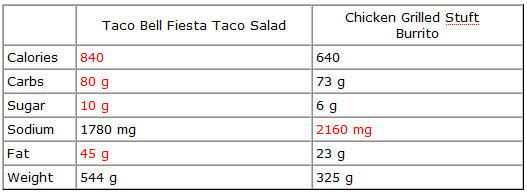
Look at the weight. Every salad here contains a lot more than the sandwiches. And obviously the amount of sugar on some of them is higher because there are mandarin oranges or other fruits. All fruits have natural sugars.. Meat doesn’t. And on the Taco Bell one, they are comparing something that has grilled chicken with something that has seasoned taco meat! Usually grilled chicken is healthier. Yes, salads may not be as healthy as they market them to be or as healthy as we hope, but at the same time, if you eat a salad with a bunch of extras on it and dressing, that will probably be your meal. If you have a burger (even a small one) you’re more likely to have fries or some other side with it. And fries are pure carbs and salt (that’s why they’re so good).
Read “Fast Food Nation” It’ll really make you disgusted in the food, but mostly how sneaky these companies are. It’s really a shame that we blindly give them so much money and they could care less about their customers and employees.
I expected more from a consumerist post. Not a reasonable comparison at all.
I did however, find the comments section full of refreshing logic and insight. Something I’ve never seen before!
All the snarky comments about why eat salads at a fast food joint, the wisdom of eating salads as part of a weight-loss strategy, salads without dressing are nasty, why eat at fast food places at all etc etc etc aside, it still doesn’t answer the basic question of what the caloric and nutritional data for these menu items sans the 5 lb. packet of dressing actually are. There’s a big difference in saying a salad has 470 calories and 19.5g fat *with* versus *without* the dressing.
@Dervish:
The low-income people who this food is targeted at are not going to have computers and internet access in order to research these things like we do, they are at the mercy of the corporation or the street corner seller for nutritional information on the food they are buying. If you are buying food from a street corner seller they most likely do not have nutritional information available for their food but I do believe legally the major franchises do have to provide that information for consumers if they ask for it. But then again that information is what the company puts out for consumers to read, so the consumers that do not have internet access to read stuff like this post here are at the mercy of what the corporation tells them.
I have looked up nutritional information on McDonalds website and they really try to beat around the bush and glorify their food on there when you go to the “nutrition” section. I was specifically trying to gauge the value of a kids meal and then they do things like saying that a McDonald’s kids meal is equivalent to a typical children’s lunch of a peanut butter and jelly sandwich and potato chips. In turn they want you to believe that it is just as good as the food you are feeding your kids at home. It is also made very difficult to work out the exact nutrition in a kids meal because of the way its stated on their website, they don’t give you the nutritional values for each individual item up front instead they give you the values for the whole package leading to a whole confusing mess in which they are just hoping that you won’t stay on that website long enough to figure out what each individual item actually has in it.
Thankfully I am one of the lucky ones who has a natural distaste for at least the burger joints such as McDonalds and Burger King, and Dairy Queen etc, because I know that if I eat the food I will get sick from it, and I do not want to get sick. I also have a natural distaste for regular soda which is perhaps a good thing as well!
I do eat Taco Bell or Subway but not on a day to day basis, I would say maybe once every 2 weeks at the most. Some of you may criticize me for eating it at all which is fine but just remember that we are all human and we have to eat, and with fast food restaurants around every corner it is very very very hard for some people to resist especially young people like myself. I am sure everyone here has eaten fast food at least a couple times in their lives and if you have you are guilty of the same crime as everyone else on this message board. If there was easily accessable, fast food company that was ACTUALLY healthy, then yes I would use that alternative as an alternative to even Subway or Taco Bell.
I would like to see a consumerist article that dispells the myth that “Subway is good for you” and that takes into account the different options you are presented with at the time of ordering (such as being able to refuse the cheese, ordering a dressing that isn’t mayo etc..).
Good points Sara.
I ate at McDonald’s last weekend for the first time in a year and I did notice that some of the packaging now has nutritional information. Is this a California thing or do other people also have this information on the wrappers now?
listen to all of your bitch because you don’t like to be told that something you thought was healthy really wasn’t. talk about burying your heads in the sand. why don’t you try changing your lifestyles instead?
——————————————–
Not trying to defend the salads, but who just orders a sandwich? An better apples-to-apples comparison would probably be the salad vs. a meal deal.
——————————————–
I just order the sandwich in the event I end up in one of these places. I don’t drink soda, and I don’t crave fries – especially when it costs $2-3 more. It’s sad more people don’t do this. The salads are a crock. Does the test bring into account dressings? What if the salad has no dressing whatsoever, and what if the diner puts the entire packet on (which most do)? If you want to lose weight, you should exercise and eat something that’s not just fat, bread and sugar. I guarantee that if you exercise 40 minutes a day 5 days a week and continue eating the salads you’ll lose weight.
This is comparing apples and oranges. Take a McDonalds Caesar GRILLED chicken salad and you’ll have only 220 calories, and with a good amount of 30 gram of protein.
This is without dressing, I never use their dressing and put light sour cream on if for 30 calories per 2 teaspoon and eat a total of 250 calories for the salad. It has 130% vitamin A and 50% vitamin C, a hamburger can never match the healthiness and low calories of a salad.

