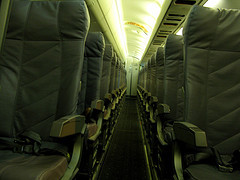
Usually when we bring up the topic of weight and air travel it involves either passenger comfort or controversial airline policies regarding “customers of size.” But some worry that outdated safety standards are actually putting people at risk while flying.
The NY Times reports on scientists who have several concerns regarding passengers over certain weight and size thresholds.
First up are the standards regarding airplane seats and seat belts that use 170 pounds for the weight of a passenger. But with the average American man weighing in at 194 pounds and the average woman at 165 pounds, is it time to rethink how seats are designed?
“If a heavier person completely fills a seat, the seat is not likely to behave as intended during a crash,” said Robert Salzar, the principal scientist at the Center for Applied Biomechanics at the University of Virginia (an awesome school in my completely unbiased opinion). “The energy absorption that is built into the aircraft seat is likely to be overwhelmed and the occupants will not be protected optimally.”
The FAA recently updated the passenger weight standards used to calculate a flight’s total weight but those changes did not carry over into any standards revisions for seat design.
With regards to seatbelts, a professor of emergency medicine at the University at Buffalo conducted a study of more than 300,000 serious automobile accidents and found that very overweight drivers were 67% less likely to be wearing seat belts, even though they are often legally required.
So that could be an even bigger problem on planes, where they are only generally required during take-off and landing.
The National Transportation Safety Board has recently recommended that the FAA collect size and weight info on travelers to investigate whether or not seat belts were effective on the wide range of passengers shapes and sizes.
Questioning Safety of Heavy Passengers on Planes [NY Times]
Thanks to Howard for the tip!


“If a heavier person completely fills a seat, the seat is not likely to behave as intended during a crash,” said Robert Salzar”
did anyone care to think that if the plane falls from the sky a seat belt will save no one?
The flight piloted by Sully Sullenberger fell from the sky and yet had every person survive.
So, yes, I imagine seat belts saved lives if not worse injuries.
Actually it did not “fall from the sky” anymore then the space shuttle did at the end of every single flight (okay two shuttles fell from the sky one one of their flights but that’s totally different.”
In a lot of crashes, many people survive the crash itself but die because they’re trapped (broken legs are the most common injury IIRC) and inhaling a metric ton of smoke.
How is it that people still think a plane crash means no chance for survival?
Correct me if I”m wrong (really!) but if the plane is in mid-flight, you really don’t have much of a chance for survival, do you? During take off and landing, you do, and that’s when most planes crash if they’re going to, so it makes sense to wear a seatbelt at that time.
The thing is, even if something happens in midair (barring something like the plane blowing apart entirely), the plane generally doesn’t just fall straight from the air. When the plane goes down, the pilot can still steer it. It’s all a matter of landing the plane (and, as you mentioned, a crash landing is survivable) under extreme circumstances.
There’s a case of a plane running out of fuel during the flight and the pilots being able to land it safely (well, it caught fire upon landing, but that was put out). (http://en.wikipedia.org/wiki/Gimli_Glider)
There’s also a case where a plane underwent explosive decompression during the flight and a huge chunk of the airplane’s roof was torn off. The pilots were able to land the plane and the only fatality was a flight attendant who was blown out of the airplane when the accident happened (http://en.wikipedia.org/wiki/Aloha_Airlines_Flight_243)
According to JJ Abrams, there is a chance for survival. But there is also a chance of ending up in some remote island where a lot of weird stuff happens. And as long as you are not an ancillary passenger, you’ll survive.
God help the pilot, that’s for sure.
Now I’m wondering if Hurley had to buy two tickets.
It’s not like the plane hits a glass wall and falls straight down, like in cartoons.
People can get hurt in turbulence, doesn’t take the plane crashing to cause injuries/death.
It seems that you would be safer firmly, snugly and securely wedged into your seat rather than being loosely tossed around between the arm rests in the event of an emergency.
They don’t fall out of the sky like wounded ducks. They can still glide and the pilot will steer them to a landing. It may not be the SOFTEST landing. Takeoff and a regular landing are the times when accidents are most likely to happen anyway. That’s why they ask you to stow all your crap, so it doesn’t turn into a projectile.
Depends on how they fall, and whether there’s a sudden stop at the end.
For example, a plane dropping 30,000 feet very suddenly then recovering generally won’t kill anyone belted in (though drink carts levitating around the cabin can royally suck) but if a seatbelt breaks because the occupant of the seat is too massive, injury or death can result as they go flying around the cabin, vomit-comet style.
What about those of us weighing less than 170 pounds?
Maybe we’ll get roomier seats?
Doubtful, but one can hope.
I can see it now. Airlines offering different sizes of seats depending on how much you weigh. And of course the smaller people get smaller seats unless they “upgrade” to medium size.
No American weighs under 170 pounds, unless you’re 6 years old; but even then…
http://highheelsandfamilymeals.com/wp-content/uploads/2010/11/fat-kid.jpg
I’m an American. I’m 5’1″ and weigh in the neighborhood of 100 (weighed in at the doctor’s last week wearing boots and fully clothed at 101).
So those seats better be safe for me, too.
Have a burger, shorty.
You’re gonna get squashed by your heavier co-passengers!
Airlines don’t care about the safety of tall passengers, why would they care about overweight ones?
yea, I feel bad for tall people.
No kidding. My husband is 6’3″. If he weighed as little as 170 he’d be skin and bones. The smallest he’s ever been in his adult life is 195 and he looked pretty slim.
my SO is in a similar boat. he’s too tall for most planes nowadays.
Weight = fuel consumption = increased costs = ANOTHER Fee to tack on, yeah!!
Height, well, people fold so they can fit anywhere.
BTW, don’t think I am blind to tall person problems. While at 5’5″ I don’t experience them directly, My immediate family:
Wife 5′ 11 3/4″ with a bad back- she HATES being 6′
14 yo daughter 5’9″ and still growing
12 yo daughter 5’6″ and still growing
So, from close second hand experience I see the problems that tall people have.
I came here to say something similar. Being big /and/ tall, I get the best of both worlds. Of maybe a dozen flights I’ve been on in my life, the only time I didn’t end up with contusions on my knees was on a JetBlue Airbus (can’t recall whether it was a 320 or 330). Every other plane I’ve been combined a short seat pitch with jagged metal parts that start at uncomfortable and within minutes become painful. Being young and in good health, I just deal with it when I have to. There’s not a whole lot of choice on the matter. But it could realistically be a life-threatening risk for others who happen to be prone to hypertension and/or thrombosis.
Tall woman here. I like to get a window seat so I can sorta bend my legs to follow the curvature of the plane wall. Otherwise it is uncomfortable. And if I want extra room like in an exit row, I have to pay extra. Grrr.
“The energy absorption that is built into the aircraft seat is likely to be overwhelmed and the occupants will not be protected optimally.”
Well, if i’m going to be protected, it may as well be optimally.
With regards to seatbelts, a professor of emergency medicine at the University at Buffalo conducted a study of more than 300,000 serious automobile accidents and found that very overweight drivers were 67% less likely to be wearing seat belts, even though they are often legally required.
Seat belts are always “legally required” when driving a normal automobile.
Most definitely not “always” — prior to 1984, there was no law requiring their use. Prior to 1968, they weren’t even required to be installed in cars.
And your point is…? The comment you replied to didn’t say they “were always” legally required, it said they “are always” legally required. Which they are. The past requirements have no bearing when discussing the current ones.
Except, of course, that they aren’t always legally required. You can drive without a seatbelt in New Hampshire.
My mistake — I was assuming that such a study would have been done using data from the past.
Dealing with data in the present is quite challenging, since it becomes the past as soon as you’ve finished observing it.
last I checked they weren’t legally required in the state of NH…
survive only to be eaten by wolves.
The part about the seatbelts makes no sense at all. Whether you wear one or not when you’re driving (and if you don’t, you’re an idiot) has absolutely no relation to whether you wear one during takeoff and landing while you’re on a plane.
The main difference is, on the plane, they actually check if you’re wearing it. I guess they could start *requiring* you to wear it the whole time on the plane.
This sounds more like the person in front of the hugely overweight person is at greater risk of harm during a belly landing or takeoff abort. That’s a huge amount of mass with a lot of inertia hitting the seat in front as the plane brakes stupidly hard. *SQUOOSH*
Fat people also make the plane fall faster if it loses power in mid-air.
Incorrect. The weight of an object does not affect the rate at which it will fall [1].
1. Physics.
Like I said on the last article about fat people on planes, there really ought to be upper weight limits for particular flights. These flights would be safer, more comfortable and, ideally, cheaper. With any luck, such a plan would also encourage weight loss, which is certainly something we need to see more of.
Yeah, and maybe we can get flights without blacks or those abominably perky gays.
Or, worse, perky black gays.
Black and gay are attributes of a person that they’re born with and unable to change. Being fat, on the other hand, is a choice they make in the majority of cases. While some outspoken fat people like to place the blame on genetics and heredity, the truth is that increased activity and decreased consumption would solve the problem in the vast majority of cases.
it’s not about the weight, it’s about the girth
I am more concerned about an emergency evacuation and getting stuck behind a 300 pound person.
You’d be better served to worry about being in front of a 300 lb. person. If they want off the plane in an emergency, there’s a pretty good chance they’re going to get off.
*groin kick* The owner of the penis will finish dead last in this race off the burning airplane.
Funny, although if your in a crash do you want trying to get the emegency exit open, a 300 lbs firefighter or a 90 lbs granola saleswoman?
The last time I was down to 300 lbs, my working sets on military presses were at 250 lbs. As in 3-5 sets as part of my regular workout. Remind me to not bother trying to pull you out if we go down on the same plane.
I thought it would have to do with weights and balances of the aircraft.
“With regards to seatbelts, a professor of emergency medicine at the University at Buffalo conducted a study of more than 300,000 serious automobile accidents and found that very overweight drivers were 67% less likely to be wearing seat belts, even though they are often legally required.”
I am failing to see how it is anybody’s fault other than the drivers who were stupid enough not to wear seat belts.
The real problem regarding weights of passengers has nothing to do with whether they’re wearing seatbelts or not, but more importantly, where they’re sitting in the aircraft. In aviation there’s an important aspect of flight called weight and balance. Aircraft may only legally take off when the plane is at or under the maximum gross takeoff weight, and the weights carried must be distributed in such a way as the aircraft is in balance between certain defined limits.
Averaging weights based on some government formula may be fine on a B747, where the actual weights of the PAX will approximate the theoretical 195/160 numbers, but on a low-capacity regional airplane full of 300 pound ham radio operators going to the annual pork-rinds convention in Dayton, using those statistical numbers could potentially endanger the aircraft. Or worse, only half-full of big people going to the pork rinds convention but all sitting together in the back of the cabin making the aircraft tail-heavy and out of balance.
I am glad that you took the time to type what I was thinking when I posted above.
*buys ticket to pork rinds convention*
I’m a heavier person, and I won’t fly. Ever. I mean, it would have to be a matter of life or death to get me on a plane, and then I would probably spring for first class if I could afford it, just because there’s more room. And as far as putting weight limits on airplanes being an incentive to lose weight, don’t you think if I could lose weight and be thin that I would? I’ve been this way my whole life, and short of having gastric bypass surgery, I’m not sure I could ever be thin like society demands.
You’re not missing anything!
The TSA will miss seeing you.
Is “People of size” the politically correct term? It doesn’t make sense. The only important adjective is omitted: “People of large size”
“People of color” — what color?
I still think airlines should charge based on total weight of the passenger and their luggage. If the average weight of a person is 200lbs(I’ll use that number to simplify), allow the combined weight of every passenger and their luggage to be, say, 240lbs. If you’re a 100lb person with 20 lbs of luggage(combined weight stamped on your ticket at check in), you get a refund for 120 lbs. If another person is 300lbs plus 40lbs luggage, they pay 100lbs in overage charges.
It’d be difficult to implement, but it’s “fair”. Fuel consumption-wise the plane doesn’t care if the weight is people or bags. Put a base charge for a seat, then charge the rest by total weight.
If you believe the airlines, they are charging for bags based on weight to save you and the airline money and from having to hop on scales prior to boarding.
Also, how the hell do you cram 40lbs into a carry on? Tired of seeing people drag in bags larger than my checked luggage and having the stewardesses accommodate these idiots.
40# in a carry-on is easy. I do it all the time for longer trips to places that require heavier winter-weight clothes and a change or two of shoes, plus a couple of bottles at the duty-free. It’s bulging at the seams, but it’s still regulation size and will fit in the overhead bin or under a seat.
I want to see some tests.
Really, I want to see some tests!
I originally read this headline as “…at greater risk for ham” and thought, “well, DUH…”
teh lulz!