
In the electronics department of his local Walmart in New York state, Joseph made an amazing discovery in the field of retail archaeology. No one was interested in these ten 256 MB flash drives, so they’ve languished. No markdowns, no clearance: they’ll remain on the shelf, with a price tag of $28.83. A cashier told Joseph, “You’ll be bringing your kids in here some day, and these will still be here.” Something to look forward to.
I was browsing the electronics section of a [New York] Wal-Mart, when I made my way to the flash storage. On the bottom shelf was a stack of about 10 of these flash drives with an absurd looking price of $28.83. Upon closer inspection it became clear that not only due to it’s off brand nature, small capacity and the fact that it touts that it is “like having 176 floppy disks on your key chain” there was a good chance these drives have been here for some time.I brought the drive to the employee working the register in that department and asked him to price check the item as I thought I might be hallucinating. He assured me that I wasn’t and explained that the reason they are priced so high is because the manufacturer will not let them lower the price (which surprised me given the fact that it’s Wal-Mart). Since they couldn’t mark them down, they were perfectly content to let them sit there until the end of time.
The cashier told me outright, “You’ll be bringing your kids in here some day, and these will still be here.” We had a good laugh about it, and he told me I should probably take a picture and share it with my friends, which I did and now I’m sharing it with The Consumerist.
Does Wal-Mart management know or care that they have dead merchandise in their store?
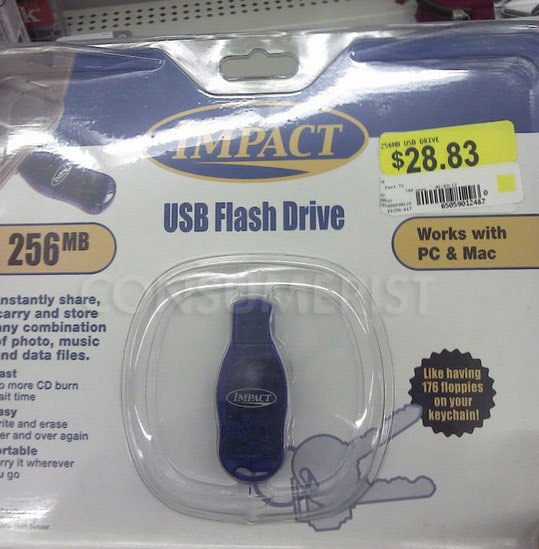
We thought Walmart had the best inventory control systems in the world. Perhaps not. After all, other readers and amateur retail archaeologists have sent us gems of obsolescence like these:
Walmart Time Vortex Yields Overpriced Memory Device
Walmart Sells Online Game That Doesn’t Go Online
This Computer Game Is On Clearance At Walmart Because It’s Now Defunct


This makes me want to find 176 floppy disks and put them on a keychain now.
I cam here to post the exact same thing…
I don’t think I even -have- that many floppy discs still lying around.
I’ve got close to that many 3.5 inch disks, packed up next to my Commodore Amiga in the attic. Just under that is a bunch of 5.25 inch disks boxed up with my Commodore 64. I might even have some 8 inch floppys there too, they would look interesting on a keychain.
I also have dozens of boxes of them in the attic. I should probably throw them out but maybe old video games and low resolution usenet porno binaries might become a collector’s item
Someone is probably selling that on Etsy.
Great, now I have to look.
http://www.etsy.com/listing/87336675/handmade-clay-35-inch-floppy-disk
http://www.etsy.com/listing/91049781/floppy-disk-geek-pendant-zipper-pull-or
Hm.
They’re meant to go on a keychain, that’s why they have that hole in the corner.
hah. I bet even fewer people here know about the write protect tab than why it was a good idea to have pencil or pen next to your hifi tape deck.
I always taped up the tab inside the tape deck so I could record on any tape I wanted.
Ironically 176 floppy disks would probably cost more today than the $29 thumb drive
Just checked at an online ” discounter” and 100 disks DS/DD black IBM Formatted $89.99
I remember getting disks free with $10 rebate
Yep, they officially stopped making them – or am I thinking of 5.25″ disks? – only as recently as last year or the year before.
You can still buy new 3 1/4″ floppies. There are still government agencies that require documents and technical reports to be submitted on them.
The hell?
The US gubment, or like Ghana or something? I mean, I know the US government isn’t exactly on the cutting edge as far as technology goes, but floppies? Really?
Aside from the lack of storage space, it’s just so easy to corrupt the data.
Government agencies are very slow to update equipment and especially slow to revise standards.
In many instances, “submit digital copies of report on 1.44 MB floppy disk” is simply a box on a checklist in a RFP. I don’t know if the data is used but not submitted all the required information can result in a proposal being ignored a report being rejected.
Last year, my office had to buy a tape drive because the Army Corps (Huntington District) wanted data submitted in that format. Also, our county wont accept CDs but they will take Zip Disks.
No wonder our government works so efficiently!
Also, thanks for reminding me about zip discs. I had completely forgotten about those. I think I have some in a box with my old Minidiscs.
I haven’t even seen a computer with a floppy drive in…probably five years. Even the mostly-donated computers at the library are newer than that…
[Citation Needed]
No citation but we routinely submit floppies to the Army Corps and various state DEPs and DNRs. For ones that have done away with the physical media requirement, the guidelines are still based on keeping file sizes under 1.44 MB; the OHPO immediately comes to mind for requiring ridiculously small files (150 x 150 pixels).
A quick google search shows many government agencies still either accept them or require them:
https://www.google.com/#sclient=psy-ab&hl=en&source=hp&q=digital+submission+floppy+disk+site:*.gov&pbx=1&oq=digital+submission+floppy+disk+site:*.gov&aq=f&aqi=&aql=&gs_sm=e&gs_upl=11229l13178l2l13353l11l10l0l0l0l0l435l2532l0.1.1.5.1l8l0&bav=on.2,or.r_gc.r_pw.r_cp.,cf.osb&fp=a901005143531e5a&biw=1192&bih=744
The citation is that I work in Payroll and we have had to submit taxes on flobby or tape drives even to this year (though thankfully this is our last year for the states we have plants).
I, being the person experiencing it, make this a primary source citation.
Yeah, I still have the option of doing my government submissions at work with either 4mm tapes or CDs. Surprisingly, there is nothing there about a floppy disk being acceptable! Thank goodness they do have a more modern way of submitting info though.
I remember “in the day” it used to piss me off when people said 5.25″ were floppy but the 3.25″ were “hard disks”. THEY ARE BOTH FLOPPIES!!
Amazon has a 10-pack for $1.15.
18 boxes of disks
1 large key ring
etsy.com account
??????
PROFIT!
I remember going to Incredible Universe for the week they were open and picking up about 8 boxes of 25 count 3.5″ floppies to back up my mammoth 240 MB hard drive.
Srsly? 100 disks for $90? Wow. I’ll have to start snagging all those unopened packs I see in the thrift stores.
That gives me shivers, and not in a good way. Too many hours spent swapping through dozens of disks installing software or trying to locate an old document or driver only to find a media fault. Floppy disks are to me what the Morris Minor is to the guys on Top Gear. Nothing short of atrocity.
This happens a lot with Walmart clearance stuff. I think every time I go down the clearance aisle at my local store, they have at least 3 or 4 3Com USRobotics Sportster modems (no, not cable modems) for like $60 each. They also have antique XM Direct adapters, for both head units and XM receivers that haven’t been made for years.
That’s scary.
You can get a brand new USB modem (not cable modem, but V.92 56k dialup) for only $20 and it is bloody tiny, almost qualifying as an adapter more than a device.
…and that’s at Staples, so it can probably be had for less somewhere . . . if you really need one.
With the introduction of the winmodem in the early-mid 90′s, the physical card in the computer is little more than a glorified connector. All the actual modulation was performed by the host processor. And this is why they were so unreliable. The state of multitasking being what it was in the win9x days, running other CPU intensive tasks would interrupt the modem’s process causing it to either disconnect or completely stall until a reboot.
I still remember the disappointment when an upgrade forced me to give up my ISA 33.6 modem for whatever was available on PCI. After the winmodem fiasco put the kaibosh on my quake game for a few days, finding that even a proper hardware 56k modem still injected an extra 50 ms into my ping time made the wait for a cable internet rollout that much more unbearable.
Bad luck there, then. I have never owned a winmodem. As a Linux user, I refused. In many cases, I opted for an external modem to achieve this end.
Also, that USB modem I mentioned a moment ago is not a winmodem. I know this because I bought one and configured it for my mother-in-law who lives out in the boonies.
Screw those x2 modems, my ISP only supports 56Kflex.
I wonder what 176 floppy discs on a keychain would look like…
hmm…
Oh sure, now it posts. :c
Hahaha, I was wondering if my post would lag-out and be all the way at the bottom. Not this time, Consumerist! Not this time!
With the number of stores, and the size of some of them, I’m surprised we don’t hear about stuff like this more.
I have to wonder if the manufacturer is still in business to even object to a price reduction.
I see these at the flea market, and it’s sometimes so hard to explain the difference between MB and GB. They think they are handling a 128GB flash drive, and it’s only 128MB.
$28.83 is a bargain. That’s probably 75% off the original price.
…10 years ago. *ba-da-bing—-pish*
No way flash drives have been available for that 10 years! Lets see I got my first flash drive my first year of college. I think it was 256MB on sale and with a rebate for about $60 from best buy. I started college in 2003… oh wait, this is 2012! Dang it has been almost 10 years since I started college?! Well I guess 10 years is probably a pretty accurate guesstimate on when this may have come out, and now I feel old!
Oh and I am pretty sure I purchased an 80GB hard drive that same day from Best Buy too because I was amazed at how cheap it was. That was the first time I think I’d seen a hard drive priced at $1 per GB (after mail in rebate and on sale of course)
My Order History on Amazon.com shows that I purchased a SanDisk 4GB flash drive from them on February 10, 2006. At the time, I think 4GB was the maximum capacity for flash drives. The price: $147.99.
More recently – November 25, 2011 – I purchased another SanDisk flash drive on Amazon. This time, I only paid $63.99… and the capacity was 64GB.
(Incidentally, the flash drive I purchased back in 2006… SanDisk SDCZ2-4096-A10 4 GB Cruzer Mini USB 2.0 Drive (Retail Package)… you can now get it for $8.99 on Amazon…)
My Win98 machine has 2 USB ports in the back. It was a Pentium 2 that had been upgraded to a Pentium 3 before I got it. Of course, when I needed to use a flash drive in it I first had to download a driver for it.
I bought a 64MB Soyo cig@r drive from Fry’s for an amazing price of ~$28 (after $50 rebate) back in 2002. It came with a neck strap, USB extension cord (the was back before PCs had front USB ports), and a driver CD for Windows 98.
I thought it was illegal for a manufacturer to tell a retailer what price they retailer can sell an item for. Price fixing, if I recall. Not sure since I’m not an attorney, but that’s what I think.
MSRP – Manufacturer’s Suggested Retail Price
Emphasis mine.
Have you MET Apple?
THIS.
Yup. First thing that came to my mind.
Minimum Advertised Price policies exist in many markets. This is why sometimes you’ll see “add to cart for price” on e-commerce sites.
It’s perfectly legal, because while the manufacturer can’t dictate what prices you charge, they can certainly not provide you with product to sell. If you want to sell their product, you have to abide by the MAP policies.
But MAP policies don’t stop you from charging a lower price, just from advertising it. I doubt that Walmart is going to put these things in their weekly flyer. They could still just mark them down to 50 cents or something. It’s more likely that they’ve just gotten overlooked by the corporate price gods than that the manufacturer is flexing their muscle here. Especially since almost no one really has any leverage with Walmart. Suppliers line up to beg them to carry their products, not the other way around.
Leegin Creative Leather Products, Inc. v. PSKS, Inc., 551 U.S. 877 (2007), is a US antitrust case in which the United States Supreme Court reversed the 96-year-old doctrine that vertical price restraints were illegal per se under Section 1 of the Sherman Act, replacing the older doctrine with the rule of reason.
The decision overruled a long-standing precedent, Dr. Miles Medical Co. v. John D. Park & Sons Co., 220 U.S. 373 (1911).
Essentially it was illegal, but the Supreme Court opened the door with Rule of Reason.
wiki aritcle…
Wow. I thought I was like the only person who ever heard of Leegin and their price fixing lawsuit.
For those who don’t know, Leegin is Brighton Collectibles. Yes, that cutesy shop in the mall that is always asking me if I want a bottled water is singlehandedly responsible for setting Anti-Trust and consumer rights back by about a century.
What’s amusing is that when I sent them a nastygram about what they did, I actually got a response from one of their flunkies who was arguing my point for me. It seems they were either very misinformed, or trying to make me think what they did was to prevent companies from charging exorbitant prices for their goods (which was not and is not illegal). It was actually the opposite, suing to force stores to sell goods for MORE THAN a certain amount. i.e., if they say it’s a $10 belt, you can’t sell it for $8 regardless of whether you want to or not.
I wrote back telling them they should actually read the case before comment on it so strongly. I never got a response back.
I once saw two USB external disk drives sit on the shelf (somewhere, they got moved around whenever they rearranged their inventory) at Walmart. These were 160GB Maxtor drives for $149.95. They were there over a period of 5 years, while physically smaller 500GB and 750GB models were priced less.
I bought a 1TB drive for less than that, before the flooding or whatever it was.
The Walmart near me does this all the time with old products. In fact, just recently I spotted 3 original 30GB Zunes, still inside the glass case under lock and key with their original price of $199.99. I did the same thing as the guy in the article. I asked if they could do a price check and sure enough, yep, that was the right price. Nevermind that they were selling brand new Ipod Touches right next to them.
Obviously not worth $200, but I’d pay $50 for an original Zune. I miss mine, them things were indestructible. But I sold mine a while back to get a Zune HD.
In another decade, they can probably get away with calling them “antiques” and sell them for an even higher, premium price!
Yep. I see idiots selling stuff like this on eBay all of the time. I love people asking $600 for a “rare” Commodore 64. Apparently there is a new definition of the word rare, you know, like when 20 million are made.
My parents still have, in their attic, the 5-megabyte Seagate hard drive they bought for their Macintosh in the mid-80s. 5 mb was HUGE, not to mention the fact that you no longer had to put the floppy in every time you want to boot.
I see this at my local Wal Mart too. They still have copies of Tabula Rasa for sale; an MMORPG that went offline years ago.
I feel a lot of deja-vu with this article on Consumerist, but I’m too lazy to check.
Here’s the store’s problem: If they mark these things down to an amount that would move them out the door, they’d be taking a $250+ loss. And they have a limit on how much they can take in that class of losses. So they’d rather use that $250 of markdown budget on a big-screen television or three that will actually leave the store (and on which they’ll still make a profit) then on a handful of stuff that probably won’t be bought anyway, and on which they’d take a solid loss. Better to let those unsellable items hang around forever and keep that asset on the books.
There’s an accounting principle called ‘Lower of Cost or Market’ that I believe should be applied in this case. It essentially says that your book value of merchandise must equal either your original cost or the market value, whichever is lower. Considering the market value of these drives is probably under $5, they should be marked down in the books to that and whatever losses are incurred booked. This principle isn’t discretionary, it’s mandatory.
In a company with as many items to sell as Wal-Mart, I can imagine that things get overlooked occasionally. I would imagine that has happened here.
I’ll bet they are already marked down. Just because the price is the same doesn’t mean it hasn’t been written down. L.C.M is how it is kept on the books. Selling price is just the revenue they hope to get from it.
if they donated them to non profit, could they recuparate a good percent of the retail price?
Just as an additional note to this. In the very same section (about 5 feet up, as these bad boys were on the base-deck) there were drives from the major brands (Sandisk ect) with 20X the storage for $10 less.
Sounds like my experiences at K-Mart. Whoever/whatever was influencing their pricing system had no clue about the progress of technology. A few examples:
– $50 MP3 player sitting next to a $130 CD player.
– $40 PS2 game sitting next to its “Greatest Hits” re-release for $20.
– Attempting to sell N64 games at near full retail price in 2004 (when Nintendo was fully on to GameCube in ~2002).
– Very outdated Palm Pilots (we’re talking 2-8MB of memory here) still selling for >$100.
– Only selling CRT TVs until 2006-2007.
It really wouldn’t surprise me if one or more “relics” like these were still hanging around on their shelves somewhere.
A few years ago (probably 2007 or so), I went in Roses’s (yes, it still exists) only to find a Nintendo NES Four Score (http://en.wikipedia.org/wiki/NES_Four_Score) still on the shelf in it’s original box. 17 YEARS after it’s release.
You should have bought it…. it is probably a collectors item since it would be in the original box with instructions.
Maybe the Smithsonian would be interested.
Agreed. You should’ve jumped on that.
I still have my very first USB flash drive. 16MB.
Wow, and I thought the old 128MB I rediscovered recently was small and near-useless!
Yet they will mark down a clothing item to $1.00 if it’s the last one in the store. This happened to me recently – I bought two pairs of pants, same label, but different styles. One rang up at $16 (as on the ticket) and one rang up at $1.00. I asked the service desk why, as I was leary of the $1.00 windfall, and she said that’s what they do with clothing items, and it was my lucky day.
I’m really surprised they leave these flash drives on the shelf as it just takes up real estate they could be using to sell something useful.
Same thing happened to me, I bought a pair of blue jeans and they rang up at $1. I asked the cashier and they said it wasn’t a mistake and to have a nice day.
I’m wondering how the manufacturer has any say in what the pricing is? Once Walmart buys the product, it’s up to them how to sell it at the right price point. The manufacturer already got their moneys.
I worked for an electronics manufacturer and Walmart was my account. Walmart won’t take the loss. They chargeback the manufacturer for the price drop.
If its in your contract. Yes.
I found an 8MB PS2 memory card at Wal Mart “on sale” for $20 like a year ago. That wouldn’t be a good deal if it were still 2004.
They might eventually sell some of the flash drives at the price. An elderly person may look at them sitting next to a 16GB flash drive, see that 256 is a bigger number than16 and buy that one instead.
Oh I do feel sorry for that grandchild though that will receive that as a B-day or Christmas present.
“OMG grandpa! you got me a 256GB flash drive! you are awesome! Oh wait, why does this thing say MB instead of GB?! I can’t even put one of my pirated movies on this thing!”
I saw a copy of Auto Assault for $10 and Tabula Rasa for $35 about three weeks ago at WalMart. Slight problem: Both are MMORPG games that were shut down in 2007 and 2009 respectively. What I found amusing was that both were being sold, through third-party resellers, on Amazon. I guess they would work great as doorstops.
About 12 years ago, I went to an asset liquidation sale for the Mongomery Ward store chain in this region. There were many relics there, such as brand-new memory expansion cards for computers from the early 80s, complete with early 80s prices. Computers and computer parts may have commanded ludicrous prices back then, but to try to sell the ancient memory for a mere 20% off its original retail price of in the neighborhood of $250 per card was just laughable. Bet that stuff went to the auction of the leftovers, and it probably didn’t even sell there.
It’s not surprising. Just last year I was in a Walmart in Ontario, and they had an N64 game (I forget which one) sitting there since that store probably opened. It was still tagged at $49.99, I just assumed they were waiting for inflation to catch up to it so they could toss it in the bargain bin without the effort of re-labeling it
He assured me that I wasn’t and explained that the reason they are priced so high is because the manufacturer will not let them lower the price (which surprised me given the fact that it’s Wal-Mart).
Shenanigans.
It’s to inflate inventory levels because you don’t want to book the depreciation on old stock.
Been there, done that.
I’ve been to stores that stopped carrying certain merchandise but forgot to clear them out off the shelves. When I tried to buy them, they rang up with some ridiculously small price. The cashier then refused to let me buy them.
At the old big box store I used to work at, items that were supposed to be pulled off the shelves were usually marked down in the system to a penny. Didn’t matter whether it was a candy bar or a 5 year old video game. The markdown in the system didn’t usually happen until someone checked the inventory and acknowledged it was pulled, but sometimes something would slip through the cracks.
The store GM is usually God with their inventory. You might be able to get that person to sell them just cheap to get them out of the store.
Otherwise they will one day just throw them away as damaged/unsellable – sort of like a tax prep software pack from 3 years ago that got misplaced in the warehouse.
do you suppose one of these would work with my 10-year-old desktop? there are none in my local wallymart.
Wow, just bought two 8GB ones at Staples for $10 each.
If I have a favorite pair of jeans that are wearing out and no longer made, I go to Sears. They usually have clothing from 1-2 years ago.
I went to a Wal-Mart in 1998 and found a copy of Breath of Fire (a then-5-year-old SNES RPG) for $5.00. It was the only copy they had, which led me to believe it got lost under a shelf or something and they found it after they renovated their video game section.
Best believed I snatched that sucka’ up!
anyone else wonders what the price is under the second price label?
My local WalMart is selling “DC Universe Online” for PC for $39.99. Which true, is cheaper than it’s launch price of $49.99.
However, since November 1st of last year, DCUO has gone free to play, and you can download the game for free from the official website!
I think they are counting on the fact that the average Wal-Mart customer probably has no idea what’s the difference between megabyte and gigabyte and does not realize how outdated it is.
You said it all when you mentioned they are at WalMart—a store definitely not know for much of anything these days, including the brightest bulbs in any chandelier.
I can just see the writing an a current-spec’d 8 GB USB stick:
“It’s like having thirty-two ‘Impact 256MB USB Flash Drives’ on a keychain!”
Speaking of floppy discs and outdated tech, I recently noticed that the image of a 3.5″ floppy disc is still widely considered to be the universal “Save File” icon (even on up-to-date software like Microsoft Office 2011 for Mac). It just struck me as equally funny and weird that the obsolete floppy still (sort of) has it’s place in today’s tech world.
Some dumbass will buy them. Everyone in retail counts on that fact!
Received notice from Laura that Wal-Mart has responded and will be removing these “dead items” from their store shelves. Case closed I guess. *shrug*
Okay, why exactly would the manufacturer care at what price their products were sold? If Walmart lowers the price, it’s not like the manufacturer isn’t getting paid as much. If anything, they’d get paid more, as more people would buy the product. And that also raises the question of why Walmart would choose to honor the manufacturer’s wishes. We live in a free market; if I owned the store I’d sell it for however much I want, and if the manufacturer complained I would politely tell them to screw themselves.

