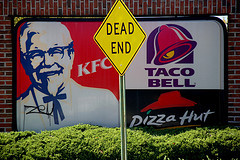
Last week, we brought you the story of an Illinois town that rejiggered its zoning regulations to keep an upscale tattoo parlor from opening. This drew several jeers from readers for the village council that made the decision. And yet, there are several municipalities around the country that have effectively banned fast food and chain restaurants from opening within town limits, and there’s barely a peep from dissenters.
There are currently at least a dozen municipalities — including seven in California alone — that have zoning laws on the books that prohibit or strongly regulate so-called “formula restaurants.” Most of the towns have not faced legal challenges on these regulations, but that could change with a lawsuit recently filed in Utah.
Investors who has hoped to open a Subway in scenic Springdale, Utah — one of Forbes’ 20 Prettiest Towns — have filed suit against the town, its officials and lawyers, claiming the 4-year-old regulation won’t hold up in court.
“We knew of the ordinance by the time we contracted with Subway, but my clients looked into it and absolutely believed that ordinance was unconstitutional,” said the lawyer for the plaintiffs in the suit.
The decision in this case could have far-reaching implications for towns that have been using zoning regulations to ward off fast food franchises. For example, there’s Sister Bay, Wisconsin, which recently issued a fast food restaurant ban after seeing a developer’s plans to open a Subway.
We don’t imagine the lawsuit will be resolved anytime today, so we’re asking you to play judge, jury and executioner in our scientifically unscientific poll:
Towns block chain restaurants to save charm [USA Today]


In Bermuda they passed a wonderful law like this right after a KFC moved in. This KFC has something like 29 varieties of fried chicken. Odd. But the only other one to slip by was a McDonald’s on the old US Millitary base. After the base shut down the McD’s shut down as well.
I really like this when I visit Bermuda even though the result has not been the flourishing of a bunch of high quality mom and pop places. If anything finding something good to eat in Bermuda is hard. Bermudan’s might argue this point but I can assure you that my visitor tastes are very different from local tastes.
What I do like is that the island has not been turned into a plastic island copy of the US. I don’t go to Bermuda because it is a place that makes me smile. I suspect the effect of fast food chains is not at all positive but that the negatives are more subtle. With their massive marketing efforts they displace the mom and pop places that while not necessarily better are different and more local in so many ways. The chains also tend to create a sense of bland banality that degrades the enjoyment of life. The employees are cogs. The suppliers are cogs. Even the owners are just cogs. Yet they desperately try to indoctrinate their employees that serving up a fries with a burger is somehow the pinnacle of life. This cheapens life.
You could probably list a hundred reasons why fast food places are good like clean bathrooms but I can list killer points like many mom an pop places buy local, certainly far more than any chain would.
If I were moving to a new area and one of the towns had banned all the crap chains and things like dollar stores and payday loan places I would give it a first serious look before its neighbors. Some people wouldn’t like this and I would be glad to not have them for neigbors.
Portland blocked a McDonald’s from opening up on Hawthorne Blvd. (formerly hippie, now yuppie street).
It now has an expensive condo or apartment complex with a healthy Cold Stone Creamery on the ground floor.
Wow, as this conversation really happened in America? Have we really got to the point where we could actually consider arguing this? If you don’t want it in your town, then don’t go there. Do you remember the good ol’ days? Any business could open and if the town didn’t like it they wouldn’t go there? In this economy you should be picking and choosing.
towns should have the ability to keep types of businesses out that they do not want in their town. what is the point of zoning boards if anyone can build, wherever?