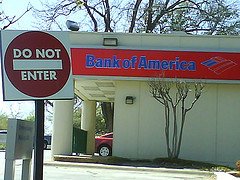
At many banks once you stop payment on a specific check, it’s dead forever. Bank of America has a different policy, though, the New York Times reports. Once you stop payment on a check, that’s just the beginning of a lifetime ordeal. You’ll have to renew your stoppage every six months, otherwise the check is fair game to be cashed or deposited once again.
Worse, every time you renew the validation you’ll have to pay another $30.
BofA customers, are any of you paying $60 a year to stop a rogue check from sapping your bank account?
Stop Payment. Now Stop It Again. [The New York Times via Yahoo Finance](Thanks, Chiko!)


How have I missed this crappy service and crummy policies at banks? Oh! Credit unions.
“At many banks…” Hey Phil, which banks are those again? I’m curious which banks were not following UCC Art 3 and 4.
P.S. All you have to do is notify your bank not to cash stale checks. Written stop payment + the notification = no worries about old checks ever bothering you again.
“At many banks once you stop payment on a specific check, it’s dead forever.”
Name one.
checks are stale dated after 6 months….therefore it is your decision whether you must place the second….also you can ask to have it until a specified date if you want it longer
OK, time for perspective-
Neither the fee NOR the expiration apply in cases of lost or stolen checks. Therefore, they are both applying to checks that people have written, but don’t want to pay. If the parties haven’t resolved the dispute (the most common reason for a stop) within 6 months, then the bank customer shouldn’t be too concerned about the fee as it could be added to a court claim.
Everybody seems to have their panties in a wad over this. Too bad most have no idea what the laws are.
The UCC provides that a stop payment is effective for six months. The bank is protected by another UCC provision if they pay the check in good faith after the stop payment expires even if the check is “stale”.
The bank is not protected from an action by their client if they fail to pay the check after the stop payment expires. What if you wanted a check paid after terminating a stop-payment or after letting it expire. If the bank would refuse to pay the item, you would have a cause of action against the bank.
As a customer, you have some responsibility. Do not write checks if you do not plan on them being paid. Know your vendors.
Wow, that’s worst company in America material. It’s certainly on the honor roll for worst consumer-related policy.
I’d just close the account to prevent the lost check from ever going through. I suppose if the customer were feeling forgiving toward Bank of America, s/he could reopen with a different account number… but I wouldn’t.
No. Closing your account won’t work. BoA will re-open your closed account, cash the check and mail you a bill for the overdraft or insufficient funds. Didn’t you know that opening an account is for life? You can close your account anytime you like, but you can never leave.
Think it over carefully before opening an account at BoA, it’s a lifetime commitment.
This is real simple. Have printed on your checks “Void after 30 days”. End of problem.
when I worked as a teller in the late 90′s… checks were considered no longer valid after six months. and that is why stop payments were only good for six months. however, if a teller is asleep at the wheel… a check dated after six months can go through the system if the date is overlooked.
No, a better question to ask is, WHY ARE YOU *STILL* A BOA CUSTOMER? BoA keeps offering new ways to annoy and offend existing customers, yet they are totally resilient to leaving. I wish I had customer this loyal. AMAZING!
This is ridiculous!
Ahhh, the free market working perfectly. If you don’t want to renew a stop check, and pay $60 per year, every 6 months then simply don’t write any checks that may get lost by the recipient, yourself or employees. And definitely don’t lose your check book or get roobed and have it taken.
i really don’t see a problem with BoA practices regarding renewing stop payment requests into perpetuity, accidental foreclosures, poor risk management (actually, when they were bailed out by the taxpayers they had limited risk so strike the last one), incompetent employees, their desire to keep all of the marbles, etc.
I thought this was universal. If the check is below $100, just task the risk of the person cashing it. If it’s more, close your account and move to a totally different bank; otherwise, they might “help” you by paying the old check against the new account.
A check? WTF is a check?
I’ve only done a stop payment for one check through BofA, but I didn’t have to pay $30 to do it.
UCC 4-403 makes an oral stop payment request valid for 14 days, if there is reasonable notice; and a written stop payment request valid for 180 days, renewable by 180 day periods, if there is reasonable notice.
UCC 4-404 extinguishes the banks warranty of honor 6 months after the date on the check. That means the bank may honor (deposit) the check, but may also refuse the check without breaching its warranty.
If your bank honors checks more than 6 months old, you need to renew your stop order. If it does not, you are good, but should still renew the order.
Just to confuse matters more, under UCC 4, post-dating a check has no effect. As soon as you sign the check it can be tendered to a bank which is then obligated to honor it. The only way to require a bank to reject a post-dated check is to give it notice under the same rules governing stop requests, informing the bank when the check should be honored. Otherwise, the bank can deposit it at any time they feel like. It is amazing how many post-date checks to third parties, only to have them deposited the same day.
Really, if you want to know anything about checks, you should read UCC Article 4. http://www.law.cornell.edu/ucc/4/article4.htm
It applies to all states except New York and South Carolina.
http://www.law.cornell.edu/uniform/ucc.html#a4
Um, a negotiable instrument (translate:check) is only good for six months after it’s dated, so a continuing charge seems rather scammy….. (unless things have drastically changed in the last few years since I worked for a bank)