In March, an evenly divided U.S. Supreme Court issued a one-sentence non-decision in a controversial case involving compulsory fees for public unions. The challengers in that case have petitioned the court to re-hear arguments — after a ninth justice is eventually appointed. [More]
teachers

Split Supreme Court Allows Compulsory Public Union Fees To Stand
By 3.29.16
A high-profile Supreme Court case involving mandatory membership fees paid to public employee unions was expected to result in yet another controversial, narrow 5-4 decision by the nation’s highest court, but today, with only eight justices currently seated, an evenly divided SCOTUS issued a one-sentence non-decision that leaves things unchanged. [More]

Teachers Call On McDonald’s To End McTeacher’s Nights
By 10.14.15
McDonald’s has several methods for marketing directly to children and parents, including McTeacher’s Nights, where educators will volunteer to work for the night at a McD’s in exchange for a “percentage of sales from the event” being donated to the school. Today, groups and unions representing some 3 million American teachers are asking McDonald’s to put an end to the program. [More]

How McDonald’s Markets To Kids Through Moms & Teachers
By 3.20.15
McDonald’s has long been a target of critics of toy-filled Happy Meals who believe that these menu offerings are used to entice kids to eat fast food. The same goes with people who call for the retirement of Ronald McDonald (though one could argue that having a terrifying perma-grin clown as the face of your company isn’t exactly kid-friendly). But McDonald’s kid-targeted marketing doesn’t rely on Happy Meals; it extends into their schools and maybe even to their homes. [More]

Walmart Offers Teachers A Discount On School Supplies (Yes, There’s A Catch)
By 7.22.14
Buying school supplies can put a pretty significant dent in one’s pocketbook, especially when you don’t have a lot of expendable income to begin with. For teachers who bear the burden of supplying a classroom full of students, Walmart is offering a new discount – but there’s a catch. [More]
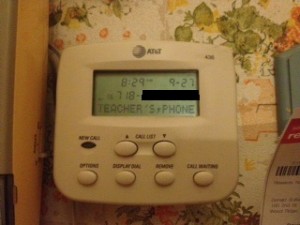
Robocallers Impersonate Teachers On Caller ID, Scare Parents
By 10.4.13
If you were a parent of school-age children and saw “TEACHERS PHONE” come up on your landline caller ID, wouldn’t you pick up the phone? If your kid’s teacher is calling you up, something must be very wrong. When they pick up the phone? A prerecorded sales pitch for “Card Services,” a classic robocall. [More]
Staples Enforces Loss Leader Limits, Makes Teachers Sad
By 7.11.12
Teachers in high-poverty school districts like Rachael provide, at their own expense, a lot of pretty basic supplies for their students. They do this with the help of back-to-school loss-leader sales at big-box office supply stores. Staples lets them buy twenty-five boxes of crayons for a penny each, and in return the teachers give Staples their undying gratitude and devotion. But Staples, at least in the Northwest where Rachael live, has stopped easing purchase limits for teachers. Teachers are now limited to two of each loss-leader item instead of as many as twenty-five. And while she understands why the company couldn’t continue this incredible generosity, it makes her sad. [More]

Rhode Island High School Fires All 88 Teachers
By 2.24.10
Do you teach at Central Falls High? Not for long. You’ve all been fired. The school is one of the lowest performing in the state and apparently the teachers couldn’t come to an agreement about how much they should be paid to do something about it. [More]

Listen Time Warner, The 60-Year-Old English Teacher Didn't Order $1,400 Of Porn
By 6.21.08
Time Warner wants reader Nancy, a 60-year-old English teacher, to pay $1,400 for ordering porn—including 17 flicks supposedly viewed on a single day. Nancy didn’t order the porn, and has no clue how the charges were associated with her cable box, but one useless Time Warner representative suggested: “maybe your dog ordered them.”

Ohio Study Provides Snapshot Of State Of High School Finance Education
By 12.7.07
Now that Ohio has made personal finance basics a mandatory requirement to graduate from high school, people are starting to look at the problem of who teaches it and what it consists of (just look at the comment threads in the two related posts below to see the wide spectrum of opinions and personal experience anecdotes). A new Ohio State University study has found that the current level of teaching is all over the place—and the people teaching it have widely varying levels of knowledge about the subject matter.

Free NYT for Students, Teachers
By 3.13.07
“It’s part of our journalistic mission to get people talking on campuses,” says Vivian Schiller, senior vice president and general manager at NYTimes.com. “We wanted to open that up so that college students and professors can have a dialogue.”
It’s now part of our journalistic mission to pretend we’re still in college. —MEGHANN MARCO