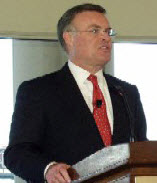
<![CDATA[Consumerist: Merrill Lynch, ]]> http://cache.gawker.com/assets/base/img/thumbs140x140/consumerist.com.png <![CDATA[Consumerist: Merrill Lynch, ]]> http://consumerist.com/tag/merrill lynch/ http://consumerist.com/tag/merrill lynch/ <![CDATA[ Ex-Merrill Lynch CEO: Whoops, I Should Have Gone To IKEA ]]> Former Merrill Lynch CEO John Thain is famous for, among other things, spending $1.2 million to redecorate his office as the company was going down in flames. For some reason, Thain's shopping spree of $87,000 area rugs, a $18,000 desk, and a $35,000 chest of drawers didn't go over well.

"I think I could buy all of the area rugs in stock at my local IKEA for $87,000, and have enough money left over to buy all my fellow shoppers an all-you-can eat Swedish Meatball feast," our own Ben Popken wrote back in the day. Thain, with the benefit of hindsight, now agrees.

"We decorated it in the style that Merrill Lynch offices were, which was very, very nice," Thain said yesterday during a speech in Philadelphia. "That was a mistake, and I'm sorry that I did that. If I had that to do over again, I'd furnish it in Ikea." His remark was met with laughter and applause at the University of Pennsylvania's Wharton Business School.
...

"John, stop by Ikea anytime," said Mona Astra Liss, a spokeswoman for the retailer, known for assemble-it-yourself furniture and in-store restaurants. She offered to show "a wealth of furniture choices" for home and office, "and feed you Swedish meatballs, too." Ikea, founded in Sweden and registered in Leiden in the Netherlands, sells a 3-drawer chest for $49.99.

See, he learns how to live on a budget now, after he's lost his job. Just like the rest of America.


Also, we would be remiss in not posting this ode to IKEA and its music video. Enjoy.

Thain Says He Should Have Furnished Merrill at Ikea [Bloomberg]

(Photo: Andy on Flickr)

]]>
Consumerist-5363314 Sat, 19 Sep 2009 15:30:06 EDT Laura Northrup http://consumerist.com/index.php?op=postcommentfeed&postId=5363314&view=rss&microfeed=true
<![CDATA[ Bank Of America Board Members Subpoenaed ]]> New York Attorney General Andrew Cuomo's office is gathering information in order to file fraud charges against some BoA executives over what they knew, and what they hid, when they acquired Merrill Lynch & Co. a year ago. Earlier this week, his office subpoenaed 5 board members to find out "what they knew regarding the mounting losses and bonus payments at Merrill before the deal closed on Jan. 1 and what role they played in deciding whether to disclose that information to shareholders," according to the Associated Press.

When BoA's CEO Kenneth Lewis fired Merrill Lynch's CEO John Thain this past January, it was because Thain had allegedly fast-tracked bonuses for employees without BoA's knowledge or approval, and had withheld the true amount of losses that Merrill Lynch faced for 2008 (a record $27.6 billion ultimately). Thain, who spoke yesterday at Wharton Business School in Pennsylvania, says that wasn't true at all:

Thain said he didn't speed up the bonuses and Charlotte, North Carolina-based Bank of America shouldn't have been surprised by the fourth-quarter loss .

"When I got fired in January and they said ‘John Thain secretly accelerated these bonuses,' they were lying," Thain said. "And that has now trapped them into a lot of trouble, because there is a document that says yes, in fact, they agreed to this in September."

Thain also joked that if he had to redecorate that office again, he would have gone with IKEA, which would have been genuinely funny if he at all meant it.

Cuomo's office is also investigating whether federal regulators pressured BoA into completing the deal whether they knew about Merrill Lynch's huge losses or not, which is what BoA executives have said.

"NY AG Subpoenas 5 BofA Board Members" [ABC News]
"Thain Says He Should Have Picked Ikea Furniture for Merrill" [Bloomberg]

RELATED
"Judge: BoA SEC Deal Violates 'Most Elementary Notions Of Justice And Morality'"
"Thain's $35,000 Commode On Legs Actually Chest Of Drawers"
(Photo: mrkathicka)

]]>
Consumerist-5362506 Fri, 18 Sep 2009 09:36:28 EDT Chris Walters http://consumerist.com/index.php?op=postcommentfeed&postId=5362506&view=rss&microfeed=true
<![CDATA[ Judge: BoA SEC Deal Violates "Most Elementary Notions Of Justice And Morality" ]]> Judge Jed Rakoff, our favorite crusading curmudgeon of the court, is at it again. And once again, he's turned his ire to the backroom deal that Bank of America tried to cut with the Securities and Exchange Commission to settle a complaint about outsize bonuses paid at Merrill Lynch before BofA took it over last year. The $33 million settlement, Rakoff wrote in his decision, "does not comport with the most elementary notions of justice and morality."

Rakoff — who had earlier warned that he wouldn't let the proposed settlement go through — had plenty of choice words for both BofA and the SEC. The deal would have forced shareholders to foot the bill to settle a case involving $3.6 billion in bonuses awarded to top Merrill brass at the same time that the company was crying poverty and begging for a savior.

The judge said the settlement plan:

... suggests a rather cynical relationship between the parties: the S.E.C. gets to claim that it is exposing wrongdoing on the part of the Bank of America in a high-profile merger; the bank's management gets to claim that they have been coerced into an onerous settlement by overzealous regulators. And all this is done at the expense, not only of the shareholders, but also of the truth.

Of course, this isn't Rakoff's first run-in with Bank of America over the Merrill bonuses. Just last month, scolded BofA lawyers who tried to cast bonuses averaging about $91,000 per employee as chump change. "I'm glad you think that $91,000 is not a lot of money," the judge said. "I wish the average American was making $91,000."

We can only hope that after Rakoff is done taking care of all of Wall Street's excesses, he goes into broadcasting. TV and radio might be filled with angry old men, but we can't imagine any of them using Oscar Wilde to slam the SEC, as Rakoff did today, when he compared the agency to a cynic who "knows the price of everything and the value of nothing."

Judge Rejects Settlement Over Merrill Bonuses [NYT]

Previously: Judge Attacks Merrill Pre-Merger Bonuses

]]>
Consumerist-5359037 Mon, 14 Sep 2009 14:18:48 EDT Marc Perton http://consumerist.com/index.php?op=postcommentfeed&postId=5359037&view=rss&microfeed=true
<![CDATA[ Judge To BoA: "I'm Glad You Think $91,000 Is Not A Lot Of Money" ]]> Recently, the SEC settled with Bank of America over charges that the company mislead its investors about the $3.6 billion in bonuses paid by Merrill as the brokerage was being taken over. U.S. District Judge Jed Rakoff, however, isn't buying it. He's refusing to approve the settlement until it can be shown that the $33 million Bank of America agreed to pay is adequate. That's nice, but he best part is that the judge is being hilariously sarcastic during the hearings.
For example, when Bank of America's lawyer (who at one point during the hearing exclaimed: "My God! Bonuses on Wall Street? It is not a matter of surprise,") explained that the majority of the $3.6 billion was shared among 39,000 employees who received an average of $91,000 each, the judge replied:

"I'm glad you think that $91,000 is not a lot of money," the judge said. "I wish the average American was making $91,000."

When Bank of America argued that it hadn't used bailout money specifically to pay bonuses, the judge was similarly unimpressed:

"Money is money, the last time I checked," Judge Rakoff responded.

Judge Attacks Merrill Pre-Merger Bonuses [NYT]
(Photo:tagurity)

]]>
Consumerist-5334953 Tue, 11 Aug 2009 12:31:46 EDT Meg Marco http://consumerist.com/index.php?op=postcommentfeed&postId=5334953&view=rss&microfeed=true
<![CDATA[ Financial Advertising Through The Years ]]> Slate has put together a sarcastic look at financial-type commercials through the years. We like the one with Samuel L. Jackson and the centaur.

From Slate:

]]>
Consumerist-5334893 Tue, 11 Aug 2009 11:43:16 EDT Meg Marco http://consumerist.com/index.php?op=postcommentfeed&postId=5334893&view=rss&microfeed=true
<![CDATA[ NY AG: Banks Paid Bonuses That Were Substantially Greater Than The Banks' Net Income ]]> New York Attorney General Andrew Cuomo's report on the bonus structures of the banking industry is out and — oh my— it's damning. The AG says that 3 banks, Goldman Sachs, Morgan Stanley, and JP. Morgan Chase, paid out bonuses that " were substantially greater than the banks' net income."

The report says that combined, these three firms earned $9.6 billion, paid bonuses of nearly $18 billion, and received TARP taxpayer funds worth $45 billion. Why did this happen? Because, according to Cuomo, when times were good the bankers rewarded themselves based on performance. When the economy started to sour — they decoupled the bonus structure from reality and kept rewarding themselves.

From the report:

As one would expect, in describing their compensation programs, most banks emphasize the importance of tying pay to performance. Indeed, one senior bank executive noted recently that individual compensation should not be set without taking into strong consideration the performance of the business unit and the overall firm. As this executive put it, "employees should share in the upside when overall performance is strong and they should all share in the downside when overall performance is weak."

But despite such claims, one thing is clear from this investigation to date: there is no clear rhyme or reason to the way banks compensate and reward their employees. In many ways, the past three years have provided a virtual laboratory in which to test the hypothesis that compensation in the financial industry was performance-based.

But even a cursory examination of the data suggests that in these challenging economic times, compensation for bank employees has become unmoored from the banks' financial performance. Thus, when the banks did well, their employees were paid well. When the banks did poorly, their employees were paid well. And when the banks did very poorly, they were bailed out by taxpayers and their employees were still paid well. Bonuses and overall compensation did not vary significantly as profits diminished.

So, how was this allowed to happen? Why did the bankers feel justified in rewarding themselves as the ship sank?

In some senses, large payouts became a cultural expectation at banks and a source of competition among the firms. For example, as Merrill Lynch's performance plummeted, Merrill severed the tie between paying based on performance and set its bonus pool based on what it expected its competitors would do. Accordingly, Merrill paid out close to $16 billion in 2007 while losing more than $7 billion and paid close to $15 billion in 2008 while facing near collapse. Moreover, Merrill's losses in 2007 and 2008 more than erased Merrill's earnings between 2003 and 2006. Clearly, the compensation structures in the boom years did not account for long-term risk, and huge paydays continued while the firm faced extinction.

The AG says that the bankers explained the need to do this by claiming that they had to pay bonuses to individuals working in divisions that were still making money for the firm. The trouble with this rationalization is that banks continued paying bonuses to people in losing divisions.

We recognize, of course, that there can be situations where the distribution of profits to employees who created real profits would be appropriate even though the overall firm may have lost money. This might be the case, for example, where one division of a firm earned large profits but another division lost profits. A principled and consistent approach would, however, balance the need to reward and retain those who created profits with the need for bonuses to reflect the overall performance of the firm. In any event, our investigations have shown numerous instances where large bonuses were paid to individuals in money-losing divisions at firms who saw either substantially reduced profits or losses in 2008.

The entire report can be downloaded from the AG's website, here. (PDF)

]]>
Consumerist-5327382 Fri, 31 Jul 2009 14:22:32 EDT Meg Marco http://consumerist.com/index.php?op=postcommentfeed&postId=5327382&view=rss&microfeed=true
<![CDATA[ Frontline Examines The Bank Of America/ Merrill Lynch Merger ]]> The merger between Merrill Lynch and Bank of America was sold to us as a marriage made in heaven that would save the financial system. It wasn't, and it didn't. Now Frontline takes a closer look at the now-infamous debacle that cost tax payers billions — and CEO Ken Lewis his chairmanship.

Things we already knew that were confirmed by Frontline:

  • John Thain, the former CEO of Merrill Lynch, is a slippery mofo.
  • Hearing Ken Lewis describe sh*tcanning John Thain is as fun as you think it will be.
  • Hearing John Thain describe being sh*tcanned by Ken Lewis is equally fun.
  • Bank of America was too eager to show Wall Street who was boss — and ended up stuck with Merrill.
  • Merrill Lynch executives were more interested in their own compensation than pretty much anything else.
  • Paulson thought the merger would stop the financial crisis and restore confidence to the markets even though Lehman Brothers went under. Paulson was not correct.
  • Austan Goolsbee says funny things in interviews.

]]>
Consumerist-5293904 Wed, 17 Jun 2009 11:29:08 EDT Meg Marco http://consumerist.com/index.php?op=postcommentfeed&postId=5293904&view=rss&microfeed=true
<![CDATA[ Worst Company In America: <em>FINAL FOUR</em> Comcast VS Bank Of America ]]> A big cable company vs a big bank. A repeat of our final match-up of 2008. Last year Countrywide (now part of Bank of America) prevailed. Which one will you choose?
It's #3 Comcast VS #2 Bank of America (Countrywide, Merrill Lynch):

This is a post in our Worst Company In America 2009 series. The companies nominated for this honor were chosen by you, the readers, and seeded according to number of nominations. Keep track of all the goings on at consumerist.com/tag/worst-company-in-america. Download the bracket here.

]]>
Consumerist-5241023 Tue, 05 May 2009 13:39:01 EDT Meg Marco http://consumerist.com/index.php?op=postcommentfeed&postId=5241023&view=rss&microfeed=true
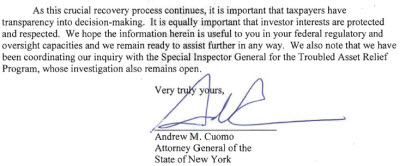
<![CDATA[ Bank Of America CEO: The Bush Administration Made Me Do It! ]]> New York Attorney General Andrew Cuomo's office is at it again. They've been investigating the circumstances that led to the merger of Bank of America and Merrill Lynch and the subsequent bonus payments to executives. In a letter to Senator Chris Dodd (D-CT), chairman of the Senate Banking Committee, Cuomo quotes Bank of America CEO Ken Lewis as saying that former Treasury Secretary Hank Paulson threatened him with removal from his position and mass firing of the board and senior management if he didn't allow the merger to go through.

The trouble with Paulson came in December, when Merrill Lynch's projected fourth quarter losses began to skyrocket. Lewis met with Secretary Paulson, Federal Reserve Chairman Ben Bernanke, Bank of America's CFO, and other officials to discuss whether or not Bank of America could invoke an escape clause in their contract that protected them from a material adverse event. (This is called the "MAC" clause.)

From Mr. Cuomo's letter:

Bank of America's attempt to exit the merger came to a halt on December 21, 2008. That day, Lewis informed Secretary Paulson that Bank of America still wanted to exit the merger agreement. According to Lewis, Secretary Paulson then advised Lewis that, if Bank of America invoked the MAC, its management and Board would be replaced:

[W]e wanted to follow up and he said, 'I'm going to be very blunt, we're very supportive on Bank of America and we want to be of help, but' —as I recall him saying "the government," but that mayor may not be the case -"does not feel it's in your best interest for you to call a MAC, and that we feel so strongly," —I can't recall if he said "we would remove the board and management if you called it" or if he said "we would do it if you intended to." I don't remember which one it was, before or after, and I said, "Hank, let's deescalate this for a while. Let me talk to our board." And the board's reaction was of"That threat, okay, do it. That would be systemic risk."

Lewis advised the board of the threats made by the Treasury and they agreed to go ahead with the merger in order to avoid any systemic threat to the financial system. The letter goes on to say that while Paulson corroborates Lewis' story, he claims to have made the threat at the request of Fed Chairman Ben Bernanke.

Further, Lewis also claims that he didn't disclose this information to shareholders at the request of Paulson and Bernanke... a charge that Bernanke apparently denies.

You can read Cuomo's letter and examine the documents he's provided to the Senate:

Cuomo's Letter (PDF)

Exhibit A: IN RE: EXECUTIVE COMPENSATION INVESTIGATION BANK OF AMERICA -MERRILL LYNCH (PDF)

Exhibit B: MINUTES OF SPECIAL MEETING OF BOARD OF DIRECTORS OF BANK OF AMERICA CORPORATION December22,200 (PDF)

Exhibit C: MINUTES OF SPECIAL Meeting OF Board OF Of DIRECTORS OF BANK OF AMERICA CORPORATION December 30. 2008 (PDF)

Exhibit D: Email To Ken Lewis (PDF)

]]>
Consumerist-5226145 Fri, 24 Apr 2009 11:36:58 EDT Meg Marco http://consumerist.com/index.php?op=postcommentfeed&postId=5226145&view=rss&microfeed=true
<![CDATA[ Worst Company In America: Starbucks VS Bank of America ]]> Expensive coffee that "tastes burnt"? Or the owners of Merrill Lynch and Countrywide?

It's #2 Bank of America (and defending champion, having acquired last year's winner, Countrywide) VS #31 Starbucks!


This is a post in our Worst Company In America 2009 series. The companies nominated for this honor were chosen by you, the readers, and seeded according to number of nominations. Keep track of all the goings on at consumerist.com/tag/worst-company-in-america Download the bracket here.

]]>
Consumerist-5202494 Tue, 07 Apr 2009 15:39:57 EDT Meg Marco http://consumerist.com/index.php?op=postcommentfeed&postId=5202494&view=rss&microfeed=true
<![CDATA[ Merrill Lynch Bonus Recipients May Be Revealed Next Week ]]> Well, it looks like the whole Merrill Lynch bonus scandal may have a Scooby Doo ending — with a judge unmasking the executives by the end of next week.

"What I am going to try to do is get a decision written in the next week or less," the judge said as the hearing ended.

Bank of America is arguing that by revealing the compensation numbers they are divulging a corporate secret — and by betraying their employee's privacy scary foreign banks will be able to swoop in and steal all their "top talent."

New York Attorney General Andrew Cuomo thinks that's a load of crap.

"Imagine, tomorrow in the Daily News, 200 names and their compensation," [a lawyer for Bank of America] said. "Americans care about their privacy. That matters to us because if we don't try to protect it and succeed in protecting it, we'll lose them to foreign banks."

So, does that mean the foreign taxpayers will have to pay their bonuses then, or how will that work?

Merrill Bonus Recipients May Be Named Within a Week (Update2) [Bloomberg]
(Photo:epichrmus)

]]>
Consumerist-5169500 Fri, 13 Mar 2009 13:05:14 EDT Meg Marco http://consumerist.com/index.php?op=postcommentfeed&postId=5169500&view=rss&microfeed=true
<![CDATA[ B of A Heiress Says Bank Is "Repulsive", Run By "Idiots" ]]> Virginia Hammerness, the 75-year-old heiress to A.P. Giannini's family fortune and a significant stockholder in Bank of America, the bank her grandfather founded in San Francisco in 1904, has harsh words for the people in charge.

In an interview with CBS 5 in San Francisco, Hammerness let loose on the current regime.

"I think its totally repulsive," Hammerness said when asked what she thinks of Bank of America now. "What idiots, what kind of idiots are running that bank?"

She's especially annoyed that the bank bought Merrill Lynch.

"They bought it and then, you know, they found out before the deal was consummated that the head of Merrill Lynch paid all those bonuses to people. Bank of America should have said forget it," she said. "I just think what's happening is just nauseating really. I feel so sorry for my children, my grandchildren, my great grandchildren and everybody else's."

When asked if she still put her money in Bank of America, she said that she did, but not because she has loyalty for the bank — but because she was too lazy to find somewhere else to put it. "That's the honest to God truth, just too lazy to move it somewhere else," she said.

Feisty!

B Of A Heiress Blasts Bank Leaders As 'Idiots' [CBS 5]

]]>
Consumerist-5160273 Wed, 25 Feb 2009 13:13:35 EST Meg Marco http://consumerist.com/index.php?op=postcommentfeed&postId=5160273&view=rss&microfeed=true
<![CDATA[ Merrill Lynch CEO: "Nothing Happened In The World Or The Economy" That Would Justify Suspending Bonuses ]]> You know how Merrill Lynch recently lost $15 billion? Remember how we're in a unbelievably huge global financial crisis that threatens to unravel the fabric of our economy? John Thain says that's no reason not to pay billions of dollars in bonuses.

NY AG Andrew Cuomo is seeking to force John Thain, former CEO of Merrill Lynch, to release the names of the Merrill executives who shared over $3.6 billion in bonuses before the merger with Bank of America. Thain is refusing, and said this about the bonuses:

"Bonuses were determined based upon the performance and the retention of people, and there is nothing that happened in the world or the economy that would make you say that those were not the right thing to do for the retention and the reward of the people who were performing," Thain said, according to the transcript.

Mr. Cuomo's office recently released information that suggests that Merrill Lynch may have moved up the bonuses in order to pass the cost on to tax payers, and claims that the bonuses were not spread evenly throughout the organization — but were structured in such a way as to enrich the top Merrill executives. Cuomo says that the top four bonus recipients received a combined $121 million, and that 696 individuals received bonuses of $1 million or more.

Cuomo said the bonuses were set Dec. 8 and not adjusted later when it turned out pretax losses were $7 billion more than expected. Merrill reported Jan. 16 that it lost $15.31 billion in the fourth quarter and $27 billion for the year.

Thain was dismissed in January by Bank of America chief executive officer Kenneth D. Lewis. The move came after disclosure of the bonuses and Merrill's unexpectedly large fourth-quarter loss.

Cuomo Seeks to Force Thain to Reveal Merrill Bonuses (Update2) [Bloomberg]

]]>
Consumerist-5159060 Mon, 23 Feb 2009 17:29:25 EST Meg Marco http://consumerist.com/index.php?op=postcommentfeed&postId=5159060&view=rss&microfeed=true
<![CDATA[ Thain's $35,000 Commode On Legs Actually Chest Of Drawers ]]> Regarding the $35,000 "commode on legs" ex-Merrill-Lynch CEO John Thain bought for his office, commenter VikramJaffe informs me that it is not as I theorized, a claw-footed toilet, but rather a chest of drawers on legs introduced by the French in the early 18th century. Too bad no one informed me of the distinction before I took a crap in it.

In all seriousness, originally they were used to store chamberpot in the drawers underneath. Then when they developed enclosed rooms to do your business, though there was no indoor plumbing so you were basically sitting on a giant removable chamber pot, these were also called commodes. Add pipes and flushing water, and why mess with a good thing you got going on let's still keep calling it a commode.

So what was this device doing in John Thain's office? Presumably, it's where he stored Merrill's mortgage-backed securities, or "night soil."

]]>
Consumerist-5137704 Fri, 23 Jan 2009 08:36:55 EST Ben Popken http://consumerist.com/index.php?op=postcommentfeed&postId=5137704&view=rss&microfeed=true
<![CDATA[ Bank Of America Fires Former Merrill Lynch CEO ]]> It seems that Bank of America didn't really appreciate that unexpected $15.4 billion dollar 4th quarter loss by Merrill Lynch — because its former CEO, John Thain has been shown the door.

From Bloomberg:

Thain, who in September negotiated the sale of Merrill with Bank of America CEO Kenneth Lewis, “agreed his situation was not working out and that he should resign,” said Robert Stickler, a Bank of America spokesman, in an e-mail.

Bank of America has been taking a lot of heat for purchasing Merrill Lynch, a deal that forced Bank of America to ask for a "second multibillion dollar investment from the government as it absorbed the mounting losses at the New York-based investment bank," says the AP.

The Wall Street Journal is even speculating that Bank of America and Citigroup may have to be nationalized.

We wonder who'll get his fancy ass office.

Ex-Merrill Lynch CEO Thain Agrees to Leave Bank of America [Bloomberg]
What if Uncle Sam Takes Over Your Bank? [WSJ]
(Photo:wmliu)

]]>
Consumerist-5137166 Thu, 22 Jan 2009 12:59:59 EST Meg Marco http://consumerist.com/index.php?op=postcommentfeed&postId=5137166&view=rss&microfeed=true
<![CDATA[ Merrill Lynch CEO Spent $1,220,000 On Office Renovation As Company Prepared To Burn ]]> Merrill Lynch CEO John Thain spent over $1.22 million to renovate his office in early 2008, just as his firm was getting ready to slash thousands of jobs, cut back on spending and dump businesses. Here's this douchebag's big-ticket tally of personal aggrandizement in the midst of financial crisis:

$800,00 to hire celebrity designer Michael Smith. He's interior-decorating Obama's White House. For $100,000. Mixing in items from Target.
$87,000 for a fucking area rug. I think I could buy all of the area rugs in stock at my local IKEA for $87,000, and have enough money left over to buy all my fellow shoppers an all-you-can eat Swedish Meatball feast. Then invest the remainder in high-yield moon-backed derivatives.
$87,000 two guest jerkface chairs
$44,000 another goddamn area rug
$37,000 six chairs for private dining room. Who has a dining room in their office?
$35,000 "commode on legs." I'm guessing that's a claw-footed toilet. Bad choice. Those gather dust underneath like nobody's business, let me tell you. Update: Actually it's a chest-of-drawers on legs. Too bad no one told me that before I took a crap in it.
$28,00 four stupid curtains
$25,000 mahogany pedestal table. I think my brother just found one of those on the curb on garbage day recently.
$24,000 "Regency Chairs." These are the kind of chairs that you use to line walls and corners but no one actually sits in and some day they end up in the Met and people are like, wow, that looks like a well-preserved, expensive, uncomfortable chair.
$18,000 "George IV Desk." You can find George I desks just as good on eBay, the advances in the later models are mainly cosmetic.
$16,000 custom coffee table. Shellacked with the blood of virgin Peruvian tribe-boys.
$13,000 chandelier in private dining room. Really fun to swing on.
$11,000 fabric for "Roman Shade." That's a euphemism for something dirty, right?
$5,000 mirror in private dining room. It's the one from Snow White.
$5,000 40 yards of fabric for wall panels. That's actually a pretty good deal. In pesos.
$2,700 6 wall sconces. Sconces are for nancies. Real titans of industry use torches.
$1,400 "Parchment waste can." Guess they were out of vellum.

Aren't you feeling good now that the government gave Bank of America a big check to buy these guys? It was vital to the national interest to prevent the collapse of the interior decorating industry.

CEO Thain's $87,000 Office Rug [The Daily Beast] (Photo: Gaetan Lee)

]]>
Consumerist-5137115 Thu, 22 Jan 2009 12:29:20 EST Ben Popken http://consumerist.com/index.php?op=postcommentfeed&postId=5137115&view=rss&microfeed=true
<![CDATA[ Bailed Out Bank Executives Got $1.6 Billion ]]> A study by the Associated Press says that executives at bailed out banks got $1.6 billion in salaries, bonuses, and other benefits — including cars, personal use of company jets, and country club memberships.

The total amount given to nearly 600 banking executives would have covered bailout costs for many of the banks that accepted funds from the government, says the AP.

The article is a laundry list of perks and multi-million dollar bonuses. Here are a few examples we really enjoyed:

Goldman Sachs’ tab for leased cars and drivers ran as high as $233,000 per executive. The firm told its shareholders this year that financial counseling and chauffeurs are important in giving executives more time to focus on their jobs.
...
JPMorgan Chase chairman James Dimon ran up a $211,182 private jet travel tab last year when his family lived in Chicago and he was commuting to New York. The company got $25 billion in bailout funds.
...
John A. Thain, chief executive officer of Merrill Lynch, topped all corporate bank bosses with $83 million in earnings last year. Thain, a former chief operating officer for Goldman Sachs, took the reins of the company in December 2007, avoiding the blame for a year in which Merrill lost $7.8 billion. Since he began work late in the year, he earned $57,692 in salary, a $15 million signing bonus and an additional $68 million in stock options.
Like Goldman, Merrill got $10 billion from taxpayers on Oct. 28.

And there's more!

Top execs got $1.6B of taxpayer bank bailout, report shows [AZ Star]

]]>
Consumerist-5116967 Tue, 23 Dec 2008 13:49:47 EST Meg Marco http://consumerist.com/index.php?op=postcommentfeed&postId=5116967&view=rss&microfeed=true
<![CDATA[ Bank of America To Lay Off Over 30,000 ]]> Bank of America has announced that it will lay off 30,000-35,000 people as a result of its merger with Merrill Lynch and the economic downturn. [MarketWatch] (Thanks, Dariush!)

]]>
Consumerist-5107893 Thu, 11 Dec 2008 17:15:12 EST Meg Marco http://consumerist.com/index.php?op=postcommentfeed&postId=5107893&view=rss&microfeed=true
<![CDATA[ NYU Cancels Merrill Lynch Resume Workshop ]]> Hm, wonder why?

(Photo: fantasysage)

]]>
Consumerist-5052372 Fri, 19 Sep 2008 12:55:58 EDT Ben Popken http://consumerist.com/index.php?op=postcommentfeed&postId=5052372&view=rss&microfeed=true
<![CDATA[ What Merrill, Lehman, And AIG Customers Need To Know ]]> NYT's Ron Leiber breaks down what you need to know and do if you are or were a customer of Merrill Lynch, Lehman, or AIG...

Merrill: If your broker leaves, you have to decide whether you want to go with him. Whether you come along or wait for Bank of America to take over, you will lose access to your funds for a week or two until the new computer systems take over.

Lehman: The brokerage unit didn't file for bankruptcy, the parent unit did. So for now, customers' brokerage accounts remain as normal. Eventually, though, they will get transferred.

AIG: While the situation is dire, they're still in business. Your life insurance policies are still good. If they go bust, state bodies known as guaranty funds will step in and cover unpaid claims and pay out policies.

The integration of different computer databases is always an opportunity for accounts getting messed up or lost. Make sure you have printouts of your recent statement and have all your account numbers and access codes memorized or written down somewhere.

What Changes in the Financial World Mean to Customers [NYT]

]]>
Consumerist-5050433 Tue, 16 Sep 2008 09:05:49 EDT Ben Popken http://consumerist.com/index.php?op=postcommentfeed&postId=5050433&view=rss&microfeed=true
<![CDATA[ Lehman Files For Chapter 11, BoA Buys Merrill Lynch ]]> Bankers worked hard over the weekend to prevent the American financial system from imploding.
  • Lehman filed for Chapter 11
  • Bank of America bought Merrlil Lynch
  • A special trading session was opened Sunday from 2-6pm to allow traders to try to unwind their positions
  • The Fed is expected to temporarily make it easier for banks to borrow from the government
  • European Central Banks stand ready to pump billions into the global market
  • Washington Mutual's new CEO's disclosure of further writedowns and setting aside of capital calmed investors and stemmed the massive selloff of its stock

Should be an exciting day to watch the stock market.

(Photo: Getty)

]]>
Consumerist-5049858 Mon, 15 Sep 2008 08:40:13 EDT Ben Popken http://consumerist.com/index.php?op=postcommentfeed&postId=5049858&view=rss&microfeed=true
<![CDATA[ Congress To Subprime CEOs: How Come You Got Paid Millions To Wreck The Economy? Hm? ]]> Congress got to ask the subprime CEOs what everyone else is thinking: Why did you get millions and millions of dollars to fail so spectacularly?

From ABC News:

"There seem to be two different economic realities operating in our country today. And the rules of compensation in one world are completely different from those in the other," said Rep. Henry Waxman, D-Calif., chairman of the House Committee on Oversight and Government Reform. "Most Americans live in a world where economic security is precarious and there are real economic consequences for failure. But our nation's top executives seem to live by a different set of rules."

In 1980, chief executives in the United States were paid 40 times what the average worker made. They now make 600 times the average worker's salary, Waxman said.

"I think there's merit to pay for performance," Waxman said. "But it seems like CEOs hit the lottery even when their companies collapse."

The panel included a who's who of failures: Countrywide Financial Corp. chairman and chief executive officer Angelo Mozilo, former Merrill Lynch CEO E. Stanley O'Neal, and Charles Prince, former chairman and CEO of Citigroup. If you were expecting these guys to take personal responsibility for the subprime meltdown, you'd be wrong.

Instead, the CEOs talked about tough economic conditions and about how they helped many Americans who might not otherwise have been able to afford homes.

Mozilo just can't seem to figure out why people are always blaming the poor adjustable rate mortgages:

"Much blame has been leveled lately at the variety of products, such as adjustable rate mortgages," Mozilo said. "Before the onset of the current housing crisis, these products were widely offered by industry because they made homes more affordable for more people and helped homeowners consolidate other, more expensive debt.

"In fact," he continued, "adjustable rate mortgages had been popular with both borrowers and lenders for many years. From my perspective, then, the issue is not so much the products, but the housing market."

O'Neal gave an acceptance speech:
"Whatever I have achieved in life has been the result of the unique combination of luck, hard work and opportunity that can only exist in this country."
ABC News says that over a five-year period, these three CEOs received more than $460 million in compensation. Mozilo says he'll give up $37 million of his $115 million parachute in order to be less "distracting."

Subprime CEOs Explain Why They Made Millions While Americans Lost Homes [ABC News] (Thanks, Natalia!)

PREVIOUSLY:Interview With An Anonymous Hedge Fund Manager
BREAKING: Bank Of America Buys Countrywide, CEO Gets Up To $115 Million Parachute
Citibank CEO Resigns, Additional $11 Billion In Subprime Damage Predicted
Merrill Lynch CEO Forced To Resign After Disastrous Third Quarter?
Merrill Lynch: We Just Lost $9.8 Billion

]]>
Consumerist-365255 Fri, 07 Mar 2008 13:37:57 EST Meg Marco http://consumerist.com/index.php?op=postcommentfeed&postId=365255&view=rss&microfeed=true
<![CDATA[ Merrill Lynch: We Just Lost $9.8 Billion ]]> johnml.jpgMerrill Lynch just lost $9.8 billion.

After taking write-downs totaling $16.7 billion, the firm posted a $9.7 billion fourth quarter loss and a yearly loss of $7.78 billion.

For comparison's sake, Merrill Lynch made $7.5 billion in 2006. So that's, like, really bad.

So what do you say when you're the new CEO of a company that just lost almost $10 billion in one quarter?

John Thain, who took over as Merrill's chief executive officer in December, called the firm's results "unacceptable"...
Pardon our language, but no fuckin' shit, John.

Merrill Lynch Posts a $9.8 Billion Loss [NYT]

]]>
Consumerist-346189 Thu, 17 Jan 2008 16:27:36 EST Meg Marco http://consumerist.com/index.php?op=postcommentfeed&postId=346189&view=rss&microfeed=true
<![CDATA[ Rumors: Merrill Lynch CEO Forced To Resign After Disasterous Third Quarter? ]]> lynch.jpgRumors are flying that Stanley O'Neal is being forced to step down after a disastrous third quarter— making him the most prominent casualty of the subprime meltdown.

The CEO met with the board over the weekend to decide who should replace him, according to the New York Times.

Truly heinous third quarter results, too large an exposure to risky subprime investments, and reports of an "unauthorized merger approach" to rival Wachovia are thought to have lead to O'Neal's undoing.

Forbes is reporting that O'Neal stood to personally gain $250 million if Merrill Lynch was sold to Wachovia, a shady move that may have sealed his fate.

MSNBC details the rise and fall of Mr. O'Neal:

After being appointed president in 2001, Mr O'Neal pushed through a drastic restructuring of the company that saw the loss of 24,000 jobs. Many who criticised the moves at the time subsequently admitted that a shake-up was needed at the bank, which had become flabby and complacent.
But some argued he was taking the heart of "Mother Merrill" and warned that his subsequent moves to put more of the group's capital at risk would end in tears. This weekend they were claiming vindication.

One business Mr O'Neal allowed to expand rapidly was the buying and packaging of residential mortgages into securities, then sold to investors.

This business made handsome profits until this year when subprime mortgage borrowers started defaulting on payments. The value of the securities that Merrill had retained on its books plummeted and last week it admitted it had written down their value by almost $8bn. That might have been enough to end Mr O'Neal's Merrill career. But further pain is likely. Analysts estimate the continued deterioration in the market has left Merrill sitting on additional losses of more than $4bn.

Executives at rival Wall Street banks say Merrill is also likely to be faced with legal actions from clients to whom it sold securities. "The struggles they are going to go through over the next two years are going to be horrible," said one senior Wall Street figure.

Sounds like Merrill Lynch is going to be a fun place to work for the next few years.

Risk-Taker's Reign at Merrill Ends With Swift Fall
[NYT] (Thanks, Brent!)
Subprime crisis seals O'Neal's fate at Merrill [MSNBC]
Merrill Lynch Set To Oust O'Neal [Forbes]
Merrill's O'Neal stood to gain $250 million from a change in control: CIBC [Forbes]

]]>
Consumerist-316234 Mon, 29 Oct 2007 11:56:00 EDT Meg Marco http://consumerist.com/index.php?op=postcommentfeed&postId=316234&view=rss&microfeed=true