


As you may have heard, a little cable show called Game of Thrones is back on TV, meaning it’s once again time for hordes of people to go online in search of free, pirated episodes. While HBO has previously turned a blind-ish eye to this unauthorized sharing, the network is beginning to ramp up its anti-piracy efforts. [More]
isp
Verizon Internet To Share Your Location With Advertisers So You'll Get Ads "Of More Interest"
By 10.5.11
As a favor to you, Verizon internet says they’re going to start sharing your local geographical location to advertisers so you’ll get ads “of more interest.” For instance, “a pizza chain may want to deliver their ad to give a special offer to people living in a particular area.” Here’s how to opt out. [More]

Verizon Monopoly Means No Home Broadband For Me
By 3.30.11
If you ever wonder why Internet service provider monopolies are a bad thing, just ask reader Icanhas. For some mysterious and intriguing reason involving pineapples, he can’t have cable. So his only option for broadband Internet is Verizon DSL, which isn’t accepting new customers in his area. Why? Well, they’re putting all of their resources toward FiOS. When will FiOS be available in Icanhas’s area? Not anytime soon. [More]
Comcast: Oh, You Wanted To Keep Your Decade-Old E-mail Address?
By 8.13.10
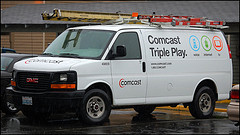
Some advice for Comcast customers: if you want to keep your comcast.net e-mail address when significantly changing your services, you should mention this sometime during the process. Nancy tells Consumerist that’s what she learned when she had Comcast combine her cable and Internet access and roll them into a Triple Play account. Sure, the installation went awry, but you expect that. She didn’t expect the company to shut off her e-mail account, since she was continuing as a Comcast customer and all. This was apparently very naive of her. [More]
By 7.9.09
../..//2009/07/09/hey-look-comcast-has-their/
Hey, look! Comcast has their very own blog! It features mostly regular company news about Comcast services and the adventures of employees and executives, but at least it allows comments. Even Consumerist favorite Frank Eliason, Director of Digital Care (aka @comcastcares on Twitter) has joined in the fun.

Comcast Giveth (Fees); Comcast Taketh Away (Fees)
By 4.30.09
Graham’s roommate is moving out. The cable and Internet are in his name, so they called up Comcast to change the name on the account. Simple enough, right? Surprisingly, it was. Until they wanted to know why there was a $10 fee to change the name on the account.

Time Warner Cable Cannot Possibly Compete With The Small City Of Wilson, NC
By 4.23.09
The city of Wilson, NC was tired of high internet, cable, and telephone prices, so they decided to do something about it. They started their own, city-owned, ISP. Now Time Warner Cable and Embarq have teamed up to convince North Carolina‘s legislature to propose bills outlawing community owned ISPs because the big guys cannot possibly compete.
Accept The Rate Increase Or Pay A "Downgrade Fee"; RCN Will Get Money From You Either Way
By 4.21.09
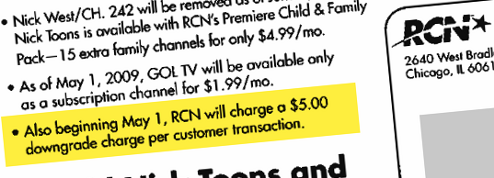
RCN knows some of you aren’t going to be happy with having your fees increased, especially in such a tight economy. They know that some of you will probably decide enough is enough and call them to request an account downgrade. They’re going to make money off of that, too.

Time Warner Cable Expands Metered Billing To Four More Cities
By 4.1.09
If you live in Rochester, NY, Austin or San Antonio, TX, or Greensboro, NC, your broadband access from TWC is about to be capped. The company is expanding its trial run from Beaumont, TX to these additional four cities, where TWC broadband customers will have to choose one of the company’s tiers of service—anywhere from 5GB to 40GB per month. DSL Reports notes that all five markets lack Verizon’s FiOS as an option, and TWC faces little to no competition from other providers.

ComcastMustDie Declares Victory Overy Comcast
By 3.11.09
Bob Garfield, creator of ComcastMustDie.com, has declared victory. Comcast isn’t dead, but he says instead of being “a vast, greedy, blundering, tone-deaf corporate colossus,” it’s merely all of the above with the exception of tone-deaf. ComcastMustDie is one of the many online different outlets for customer rage that Comcast has tapped into to proactively respond to customer complaints. They still have a long way to go, but at least they’re listening. That is all Bob really wanted, it seems, as he’s moving on to a new project, CustomerCircus.net, that will solicit and broadcast consumer complaints against all kinds of companies. And yep, Comcast will still be one of them.
Google Takes Stance Against ISP Bandwith Throttling
By 1.29.09
Google has decided to throw its weight around when it comes to Net Neutrality; the search giant announced a plan to let end users see what their Internet Service Providers do with their bandwidth. What does this matter to you, the aforementioned end user? Inquire inside.

Warn Comcast You're Moving, Lose Your Internet Access
By 6.16.08
Chris gave Comcast a heads up that he was moving and wanted to arrange a transfer date ahead of time, and they disconnected his present internet access instead. Gahhhhhhh! Ahhhh!!! When he made various calls to various Comcast departments, various employees agreed it was messed up, but all refused to actually solve the problem. So Chris, using some email addresses we posted, sent out a well-crafted executive email carpet bomb…

UPDATE: Charter Will Track Your Internet Activity Regardless Of Whether You Opt Out
By 5.20.08
Last week, we wrote about Charter’s decision to begin tracking its users internet activity and inserting targeted ads. One of our readers wrote in to let us know he discovered that Charter’s insecure opt-out solution—downloading a cookie that must be downloaded for each user and browser, and downloading it again whenever the cache is cleared—only blocks the ads from showing up; it doesn’t block Charter from monitoring users’ searches and web activity.

Charter To Begin Tracking Users' Searches And Inserting Targeted Ads
By 5.13.08
Charter Communications is sending letters to its customers informing them of an “enhanced online experience” that involves Charter monitoring its users’ searches and the websites they visit, and inserting targeted third-party ads based on their web activity. Charter, which serves nearly six million customers, is requiring users who want to keep their activity private to submit their personal information to Charter via an unencrypted form and download a privacy cookie that must be downloaded again each time a user clears his web cache or uses a different browser.

Quit AOL Using Highlighters
By 4.24.08
It looks like AOL is up to its old shenanigans and is still making hard for some people to cancel service (yes there are still some people using AOL), but reader Richard figured out a way to finally get through to them, with a highlighter. He writes:
I could not find a way to contact AOL to stop my service. So I took a yellow marker, drew a line though that line item on my credit card bill, and wrote on the bill….”Do not pay, account in dispute”. I paid all the other items on the CC bill that month. It took AOL about 2 weeks to call me…..I told them what I thought of their service, and instructed them to terminate my account, while I was still on the phone. It worked. They seem to understand when you tell them you are not going to pay.
That’s one way to go about it. You could also call up your credit card company and request a chargeback, but this has the added benefit of zero hold time. First rebates, now AOL cancellations, this highlighter is starting to look mighty potent.
Comcast Apologizes For Tech's Van Blocking Driveway
By 4.17.08
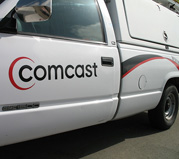
Frank Eliason from Comcast Executive Customer Service provided the following statement regarding the San Fransican whose Comcast cable service mysteriously shut off 10 minutes after asking a tech to move his van from in front of his driveway:

