
Student Loans, Gateway Drug To Debt Slavery
studentloanschemescheme.jpg

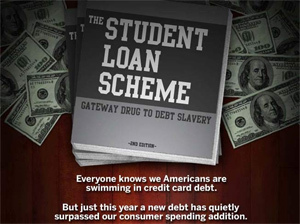
One of the most important lessons students learn in college is how to get into debt and stay there. It’s crucial to the success of the Republic. An indebted population is easier to control; needing to pay off crushing debt – a debt that if defaulted on has been stripped of many normal consumer protections and rights – graduates more willingly shuttle into cubicles, becoming the square pegs demanded by the square holes. After a few futile years of floundering idealism, their souls have been successfully jackbooted into powder and they’re ready to keep the thumb on the next generation of would-be drones so as to protect their empire of matchsticks. But how did we get here? This chunky infographic examines the origins and (d)evolution of the student loan leviathan.

Comments

  1. NickelMD says:

    One problem is that students see a price tag on school and they are willing to let the whole thing be paid for by loans. I finished undergrad and medical school with about 80k in debt. The reason was partially that I went to state schools, but also partially because I worked at least part time every single year. I also took three years off after undergrad to pay down some of my loans before I accrued more in medical school. If your schooling will cost $100,000 over 4 years, why not work summers and part time during the year, live on the cheap and owe 50k at the end instead of 100?

  2. technoluster says:

    “school tuition has risen at twice the rate of inflation and four times the rate of wage growth”
    This is the part that burns me the most. Our local university fought very hard against a proposed community college while they kept increasing the price of an hour’s education.

  3. crazydavythe1st says:

    I’m about to graduate, so I’m a little worried about this. I went in state, worked summers, and tried to keep things as “frugal” as possible. I’m going to owe about $60k for an electrical engineering degree, so I actually feel somewhat okay, but it is still worrying in this economy (and since I’m still looking for work).

    Also, as far as federal loans go – you may not be able to discharge the debt through bankruptcy, but there are some newer protections that aren’t mentioned that really help students. For example, with the new direct loans, you can choose to base your payments on a fixed percentage of your income. If I recall, you automatically have the debt discharged after twenty years if you weren’t able to pay it off completely. I think you can get it discharged after ten years if you go into public service or something like that. Also, Wells Fargo sold most of my loans to the government (which are deferred until I graduate), which allowed me to gain some of these newer protections on my older loans if I understand everything correctly.

  4. aleck says:

    I am glad the government made the loans non dischargeable. If they guarantee the loan, they should have the laws to enforce the repayment. I wish they did the same with mortgages.

    To a large extend the problem exists because a lot of college students are encouraged to do “soul searching” or “deciding what they want to do” while in college. So, we have people sitting in school for six years at $30,000 a year, majoring in “Women Studies” graduating and getting a job as a waiter.

    If you or your parents can drop $100,000 for pure “college experience”, fine. Otherwise, get a grip on the reality, figure out what you want, major in something marketable, get a job and pay off your debts. Or better yet, get good grades in high school and get a scholarship.

  5. ModernTenshi04 says:

    Student loan debt has definitely made me wary and loathsome of credit. My debt isn’t impossible for me to manage, but it’s a pain in the ass, especially since I just had to go to the private school. Sure they paid for 1/4 of my education with an academic scholarship, but that’s not much when the bill will total more than $80,000. I could have gone to the state college (in this case OSU, which is definitely a pretty high ranking state college), and paid half that. Even if I had to pay for it all myself, my student loan debt would be $20,000 less, and my loans even more manageable.

    I have a credit card, it’s completely paid off right now, and I plan to keep it that way for quite some time.

  6. mdovell says:

    The article is great although I would say it can be shortened into this:

    Demand is subsidized to make it easier to get..for the most part nearly anyone can get in (pending grades of couse but no one in their right mind with say a 1.0 in high school would bother going to college)

    Supply is NOT being increased. Instead of seeing new schools opening up we have current schools expanding.

    Academia is one of the last places fighting technology tooth and claw. What I mean by this is there is a tendency to look down on online schools (U of Phoenix comes to mind). This is odd given how much of academia is electronic. No one hand writes papers anymore..everything is in some electronic office format one way or another. Blackboard and Moogle are also used by schools. With books ebooks are going to eventually take over but it is going to take time. Kindle 3 is out now but I’m sure within another few years they are going to have to put books on ereaders…instead of having to physically buy a higher version it could be a smaller fee to update the version. It might be a good idea to mandate like some states have to release the ISBN’s of textbooks PRIOR to the first day of class. This can safe students time and money..just as textbook rentals can as well.

    The big 900 lbs gorilla in the room is what if employers buypass education? The vast majority of students go to school because they want a better job. Having said that what if some employers mearly pool their resources and define what exactly what they want their employees to have for requirements. Employees are more apt to want to get educated if they know there are more options. As it stands now employers training programs are basically invalid against each other. Sure there are some standards in an industry that look good (clean safety record) but this would have go further than that.

    • MomInTraining says:

      Some universities are fighting technology, but most schools do offer online classes. My university adds about 20 new online courses to the schedule every semester. Students can get a fully online Bachelor’s degree if they piece together the right online classes. I think that technology is still expensive though and other than convenience, is not cheaper, if done well, than traditional classes.

      BTW, as far as books go, the Higher Education Opportunity Act requires all schools receiving federal financial aid to link the textbook information from the online course schedule. If your school is not doing so, they are in violation of provisions that went into effect on July 1. Learn more about what publishers and schools should be doing in relation to text books in this Dept. of Ed Dear Colleague Letter. http://ifap.ed.gov/dpcletters/GEN1009FinalTextbookGuidance.html

  7. MomInTraining says:

    I used to work at a student loan guarantee agency. I have some serious problems with the way the process is depicted in this diagram. First, the idea of using Sallie Mae as an example and saying that Sallie Mae will get paid if the loan defaults and then mentioning in footnote that the law has changed is misleading. The banks are now out of the federal student loan system. End of that story.

    I also know in the 270 days leading up to default, the borrower is contacted numerous times. There are so many options for student loans including deferments and forebearances. What other loans can be forgiven if you become disabled? Do you think your bank will forgive your car loan? So if you work with your lender during the pre-default period, you can work our an income-based repayment plan that can fit in your budget. No, you might not be able to buy your $45,000 vehicle, but you did take out loans that you do have to repay.

    Also, it is misleading to say that these loans even after default went to a collection agency. Most of them went to a guarantee agency like my former employer. There, and through all guarantee agencies, if you could make 10 payments in a 12 month period you could get out of default. The only time we used a collection agency was for borrowers who had been on the books for a long time or that we could not find.

    Also, schools do get tuition even if a student defaults, but they can lose their ability to offer federal financial aid if they have high default rates. And those levels are actually being lowered for schools, so they have incentive to keep students from defaulting.

    I got through a BA and an MA program and had my student loans paid off within a year after graduating. I didn’t pick the most expensive schools, lived cheaply while in school, didn’t pay for a sorority, worked during the summer and while in school, and got grants and scholarships. It can be done, but students have to be willing to work for it and make sacrifices. I think a lot of the problem is that students feel entitled to live like working professionals while they are in school. They want a smartphone, to drive a nice car, have a gym membership, live in a nice apartment, wear Abercrombie clothes, go on vacations, etc. Much of that gets financed via student loans.

    We also need to do a better job making sure that students get jobs when they get out of school and understand that if you get a degree in Philosophy, you will have a harder time getting a good job after graduation. We also need to push technical and trade schools. A BA is not necessary for every job and a certificate program in many cases is a more efficient way to get into the workforce.

  8. Al Swearengen says:

    The entire point of bankruptcy is to allow people a fresh start should they absolutely screw themselves financially. Yes, people should pay their debts if they could, but what good does it do the students and society to turn them into debt slaves for 30 years. What kind of risk taking dynamic society are we going to have if people cannot get rid of debts they acquired through taking a risk in education, the very risk that is pounded into their heads from the very moment they walk into kindergarten – you must go to college or you will be a failure. Yes, getting an education is a risk, just like the risk of starting a business, there is no guarantee of success. But why do we allow risky behavior in business to be written off, but we don’t allow risk in developing a better educated workforce to be written off?

  9. istheleftright says:

    Screw it. Just give a free education to people. Get off this money is your god train.

  10. Datruth says:

    So what, exactly, are people hoping for? A free ride through college? The ability to default on a whim because it’s easy, and hey, you’re young so what does it matter?

    How about joining the military and getting college paid for? How about everyone going to community colleges for the first two years since your final degree can always be at your vaunted “prestigious” university? Or even better, finish your degree at a state school vs. a private university. How about assessing what college is actually going to cost beforehand, so you don’t need to use the “but I didn’t know” mantra?

  11. budsmoker says:

    “How about everyone going to community colleges for the first two years since your final degree can always be at your vaunted ‘prestigious’ university?”

    I always laugh when I read this advice, because it’s a giveaway that someone doesn’t know what they’re talking about.

    First, prestigious universities tend not to accept transfers, especially from community colleges. The assumption is that the student wasn’t good enough to get into a “real” school.

    Second, the education at most community colleges is low-quality and not rigorous. “High school with ashtrays,” as the saying goes. This is because top students don’t go to community colleges.

    Third, if you do not disclose the community college on your resume, you’ve technically committed resume fraud, which can get you fired. (Of course, if you *do* disclose the community college, you’re probably not getting the job.)


