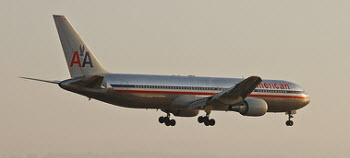
The Wall Street Journal is reporting that structural cracks were discovered on at least two American Airlines Boeing 767s, and air-safety regulators believe that one of them “easily could have lost an engine.”
The FAA said it was working with American and Boeing to “identify the source of the cracking,” said the WSJ.
“We are considering additional action, including requiring more frequent inspections” of the engine pylons, an FAA spokesman told the WSJ.


There’s a potential Donnie Darko reference in there somewhere…
Why are you wearing that silly rabbit flight attendant suit?
Why are you wearing that silly man flight attendant suit?
Or human, whatever
Someone remembers that movie?
are you kidding? that movie is amazing and a cult classic! (sry…donnie darko fan here)
Shades of the American Airlines DC-10 over Chicago a few decades back. I often wonder if their lack of paint leads to greater corrosion of the metal components on their aircraft. I know the weight savings benefits them… but do they also increase inspection intervals because they fly their planes naked?
Lack of paint of just lack of maintenance? With airlines cutting costs everywhere, including making flyers pay for their luggage, just what else are they cutting back on? And more importantly why are hearing about these issues more and more these days. Remember, crack kills….
Did you know that a 747 requires more than 700 lbs of paint?!
Did you know that airplane paint processes are super-proprietary? When I got a nice personal tour of Boeing’s Everett plant (yay knowing people), the one thing they absolutely would not let us near was the painting process. It’s got to be directly related to this weight problem.
the dc10 thing was due to an upper management guy wanting to save some man hours (money) and using a procedure to remove engines that was not approved.
go here and scroll down to maintanace records. all to save a buck.
http://en.wikipedia.org/wiki/American_Airlines_Flight_191
Were these managers the same ones now working for BP by any chance?
As someone who happens to have a degree in aerospace engineering I’d have to say “Not likely”
Unless operated in high salt environments on a continual basis (ie at sea with say the Navy) corrosion is typically not an issue with the commonly used aerospace grade aluminum alloys.
Structural cracks are almost always caused by high cycle metal fatigue. The fatigue life of a component by the average stress loading it sees during a cycle (ie a flight). The higher the average stress, the fewer cycles before cracking and failure.
What is probably happening is the component is seeing loads somewhat higher than anticipated by the designers but still within the limits driving up the averages and reducing the life span of the component requiring more inspections and replacement.
This sort of thing is the very reason we do so much inspection and maintenance of aircraft…
Thank you for the real explanation. It makes lots of sense and it’s greatly appreciated.
Thanks for the real explanation. It’s greatly appreciated and it makes a lot of sense.
Isn’t it true that you are much more likely to see this sort of metal fatigue on aircraft that are used on frequent short hops rather than less frequent long hops because of the amount of expansion/contraction experienced by the airframe during the ascent and descent?
Yes in a sense. The more load cycles an airframe has, the more likely you are to see structural fatigue issues such as cracks.
An aircraft that flys from say Boston to NY and back 6 times a day will see more cycles and thus more fatigue than one that only flys from NY to LA and back a couple times a day.
For most commerical airliners a cycle is defined as a takeoff, climb to altitude, desecent and landing because that generates all the typical loads an airliner sees.
That’s what I thought; thanks for clarifying.
This is why I make my 767-200′s at home.
I wonder if they’ll get fined 10 million dollars.
Now they will start charging a mandatory engine retention fee.
Win.
I think we can all agree here that the fee will have a more general title like
Fees:
Baggage $99
Plane inspection fee *$99
Federal regulatory fee *$99
* These fees are not mandated federal taxes, but are recovery fees we are allowed to force on our customers sanctioned by the federal government.
These planes are painted just the same as others – Just with a metallic coating instead of another color.
Structural cracks are common in long-service airliners. Part of what they’re looking for during ‘Inspections’ is these cracks that have to be repaired. Finding many of them isn’t a failure of the plane itself, but rather a failure of the inspection and regular maintenance program the airline needs to follow.
I always found this interesting: Airline windows are that rounded square shape because the sharp corners of square windows become stress points that create a lot of structural issues.
And make it easier for gremlins to get in.
I’m certain that American does not paint their airplanes (other than the livery) and simple research bears this out. They occasionally polish them but most of their metal surfaces are unpainted.
Correction, not metallic. Its a clearcoat.
Oh joy I’m fly American on monday.
Try not to jump around a lot, you might shake an engine loose.
Can a jet land with only one engine?
Can a 767 land on one engine ?
Yes it can. It can also take-off on one engine if it is not too early in the in the rotation cycle* while the plane is full of fuel, baggage, and meatbags.
Fortunately for all of us, The DC-10 Chicago incident is also one of the main reasons why pilots train in simulators for losing an engine (either thrust and/or physical loss) during the takeoff / landing cycles. Nothing is nastier for pilots and aircraft than asymmetric thrust conditions during flight.
*Roatation Cycle is the condition where the plane does not have enough airspeed to fly on its own and is relying on engine thrust to keep it in the air. Typically this event is during the time when you feel the rear wheels lift off the ground to when they are folded for flight.
Interesting! Yeah I imagine it would be hard to control, seems like the plane would want to spin.
I feel a little better now knowing it is possible to land with one engine. Of course I still drug myself before flights with a helpful Rx from my doctor – 2 pills, one for each flight to and from vacation. It’s for my own good, and the good of the people around me on the plane.
I know all the safety statistics, but they do my irrational phobia no good.
Pilots licensed for multi-engine aircraft practice engine out flying. And the engineers who design airplanes think about this stuff when they do their job.
It would be awesome if I could read the fucking article. Thanks WSJ.
http://www.Bugmenot.com ?
Try this link:
http://online.wsj.com/article/SB10001424052748704256304575321413262312110.html?mod=WSJ_WSJ_US_News_5
Sorry – it worked when I Googled “Cracks Found On Some Jets” and scrolled to the WSJ link. This usually works for me RE: getting around the WSJ subscription requirement. I don’t know why it defaulted back to the subscription only version when I pasted it here.
Nothing a little duct tape won’t fix.
In aviation it’s called speed tape. And we use it all the time.
…and never for primary structure.
Is this any worse than the ghetto crack found on ALL Airtran flights?