
Use Snowball Method Spreadsheet To Pay Off Debts
Do you have so many credit cards that you could sew a pair of pants from them? Confused as how to get rid of them? Try this handy Excel spreadsheet to generate a custom strategy for becoming debt-free.
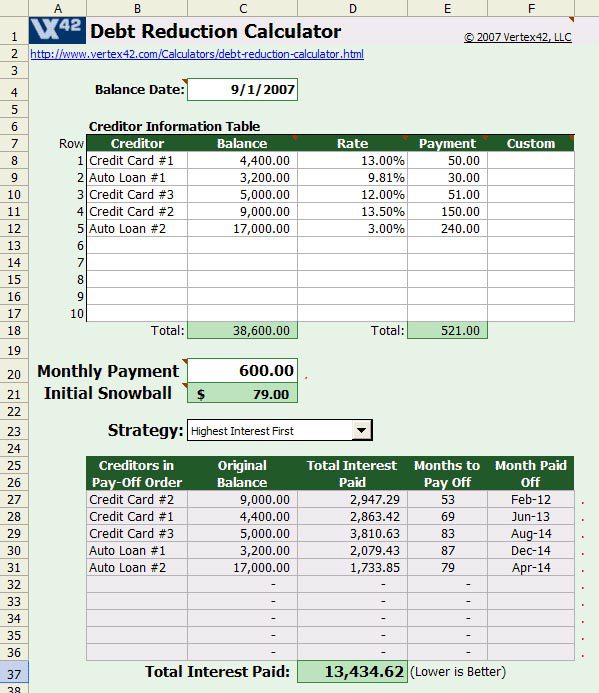
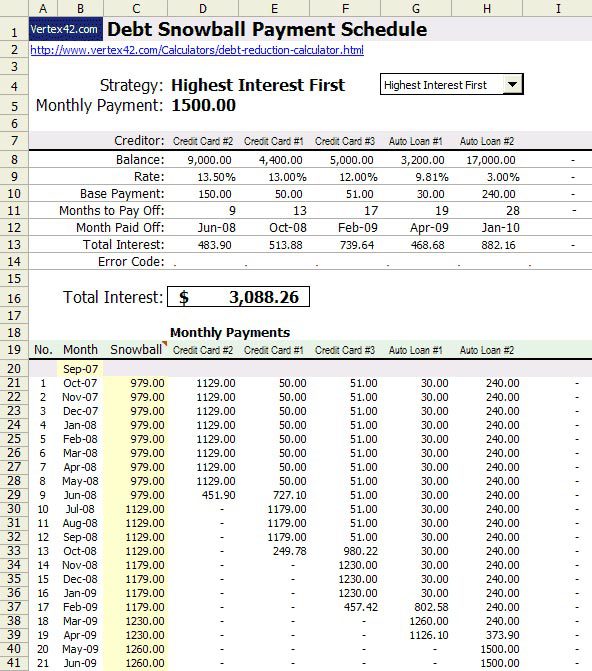
Just enter your credit cards, their balance, and interest rate. Then enter your required minimum monthly payments and the maximum possible amount you could put towards it, based on your budget. Select which style of repayment you want, such as snowball or highest interest first. The program then spits out an effective payoff strategy. It calculates how much interest and the total you'll end up paying, and how long it will take to escape the shackles of debt.
If you're carrying multiple balances, this is a great tool for getting started on, or optimizing, your personal debt payment plan.
Debt Reduction Snowball Calculator [vertex42] (Thanks to Matt!)
SCREENSHOTS:
Post a comment
Comments:
@BaronVonCrogs: Definitely - but if you're in too deep maybe you can't get one bigger credit card to cover them all.
@BaronVonCrogs: It might be, but you're also paying fees to just do the transfer. Also, the point of this is to be rolling what you were paying on Card 1 to Card 2 when you're done.
In reality, yes, what you mentioned might be marginally better, but it'd probably be $50 over a course of a year, if even that. Getting out of debt is more of a mental change than anything, getting out of the habit of spending more than you have.
I use that spreadsheet myself. Two things stand out. (1) I can't believe it's free, because it's so comprehensive, and (2) It's so advanced. I didn't even know you could do that kind of stuff with Excel.
It's so incredibly simple. You just plug your numbers in and it will put them on the second sheet in just the right places. Then you can choose your strategy and watch the numbers change in real-time.
yeah it might save interest but the snowball develops good habits. though you might (and i did say might) save money if you consolidate everything most people with big debt don't stick to the plan because it seems overwhelming....if you see 80,000 in and you are only making $500 or even $1000 payments each month it's going to feel like it's taking forever, whereas if you pay them off smallest to largest you get small victories along the way and can get excited when you pay something off. I think people are more likely to stick to the methods where you pay one at a time instead of consolidating. it's too easy to consolidate all the cards pay the minimum build up your credit and run out and get another credit card and put yourself right back where you started....with more payments than before.....payments suck....credit sucks....I'd rather pay myself :-)
@Tux the Penguin: Exactly right. The reason why debt consolidation doesn't usually work is because the behavior change didn't come first.
@battra92:
Indeed it is. Consider yourself lucky.
I've been unemployed outside a few temp jobs since I graduated over a year go. Luckily the student loans are in deferment otherwise I'd be "up the creek" as they say.
@Tux the Penguin: The $50/yr savings is not entirely accurate. When I went from a 18.9% card to a 5.49% card, I was saving almost $100 a month in interest alone. Granted, I lost my ability to earn airmiles... but I think it was a worthy sacrifice.
@graffight: if you see 80,000 in and you are only making $500 or even $1000 payments each month it's going to feel like it's taking forever, whereas if you pay them off smallest to largest you get small victories along the way and can get excited when you pay something off.
This is why student loans are so horribly oppressive and depressing. I send them as much monthly as I send my landlord but I'm never any closer actually to making them go away. I mean, technically I am, but who can tell? Maybe in 15 years I'll be able to notice the difference.
I think Dave Ramsey is right on this stuff and that's why I go with the snowball. He says that while you might save a few bucks using the "pay off higher interest first" method, debt is a highly emotional thing. Most people will have more success because it's fun to get a card completely paid off and when you attack the smallest debt first you can "catch the excitement" more quickly.
I have a simple Excel sheet that I have been using to reduce my debt. So far so good but this spreadsheet looks like it might be better equipped to help me reach my goal.
The largest chunk of debt for me are my student loans. Now that I have finished grad school, I can expect in 6 months to shell out close to $500 in loans!
Perhaps you could use this another way: a savings tool. Decide how much a few things will cost and put them in as credit card debts but in reality, it's money you're transferring into a savings account. Then experiment with the different strategies to see how fast you can get the things you want to buy.
The interest rate could be used as a proxy for importance.
@EtoilePB: Don't worry, they WILL start looking smaller eventually. We just round up to the nearest hundred, and the yearly payment amount adjustments make me feel good about myself and feel like I can see the light at the end of the tunnel. And if your loans are grouped and you can focus on paying of one group at a time, that helps a lot.
It is mortgage-esque, though. The incremental victories in payoff are very small at first, and it IS a long slog.
@shockwaver: Well, you had close to 9k transferred from the high rate to the lower. That's a really nice credit limit that I doubt many people have.
But yes, that's an immediate savings, but I was also figuring in the "savings" from eliminating part of your debt from a card. I mean, if you roll it into another card and then make the "snowballed" payments, that's great. But I think we both know that the average American will 1. Still only pay the minimum and 2. use that newly "clean" card to get stuff.
IMO, someone who got into that sort of financial situation in the first place probably isn't going to be able to stick with the whole snowball thing. They might want to look at some other snowball method to pay off their debts :D
Right, because people can't change their behavior to improve their life. Ever.
When you are 18,000 in the hole on credit card debt, the last thing you should be doing is buying a new car. (Auto Loan #2 at 3.00% APR is a new car... you can't really get that low of an APR on a used car loan) I'm not being judgmental, but uou should have a used car or basic transportation until your finances are in a little better order.
Brand new cars are an unneeded extravagance when you're already in the hole bigtime.
@stinerman: I guess.
I also worked two jobs to get myself through college and my parents let me live at home with cheap rent so it helped.
Hurt my social life, of course ...
Interesting...
I cooked up a home-brewed excel spreadsheet to help me figure it all out about a year ago that I constantly tweak, and the results were eerily similar. I like that it could show me the differences between the methods. I've been using the snowball method, but was thinking about using the highest interest first method. Switching to that would shorten my debt reduction plan by 1 month and reduce interest paid by about $400. That's 2/3rds of the PS3 I've been putting off buying until I have paid all my CC debts. Hmm... decisions, decisions.
(I'm the original poster)
Between my wife and I, we have 4 student loans (I did a professional degree), a car loan, and 2 credit cards.
To answer some of the other commenters: We can't consolidate for various reasons. Some of the student loans have low rates that a bank probably wouldn't beat. Also, as someone pointed out, most credit card transfers have fees attached that would negate any savings. And given our high level of debt, we had trouble even getting approved for a car loan.
What I think is really nifty about this spreadsheet is the ability to change interest rates on the fly. One of my student loans is fixed, but most are variable. I like that it can give me an accurate payment plan as things change.
Also, BuddyGuyMontag, the numbers in the screenshot are the default values that come with the spreadsheet when you download it. I don't think they represent a real person's finances.
@krn:
Spent the last 45mins getting this to work for Open Office.
The Index function does not "port" over correctly but easily fixed (ex: took me 2 mins to fix this once I figured it out. And I am by no means open office or excel savy...in fact I'm a domestic godess).
There is a hidden sheet "Order" ==> Click on the scroll bar/drop down that list the ways to sort the list, then select Format=>Sheet=>Show. This should bring up the "Order" sheet. You will see a bunch of Err:504. For each Error cell you will see something like this formula
=INDEX($B$21:$U$21;C30) you need to change it to =INDEX($B$21:$U$21;1;C30)
Notice the addition of the "1;"
Just keep at it for all the cells.
Best of luck. This tool looks AWESOME.
I love the judgy-judgy comments - my debt load would set off a few alarms, but there is no telling what went onto credit cards to generate the debt loads. If I had known then what I know now (that hospitals wil work out a payment plan), I would never have charged my uninsured-self's broken arm...they asked for payment while I was still waiting in the er, I handed over my BOA visa. BAD BAD BAD idea. But I was a dumb kid at the time.
I'm loving the judgy comments too, especially since the data is dated 9/1/2007 and probably is hypothetical. As much as I love reading the consumerist, some of the comments approach a level of smugness typically associated with prius owners.
The spreadsheet is awesome though.
@DallasPath: I love it too - especially as I manually created a similar output one this weekend. According to my calculations (again - manually redistributing the debt snowball EVERY Month - what a PITA!), I wouldn't be out of debt til August of 2013. This spreadsheet was able to tell me that I screwed up my home-grown spreadsheet & that I'd be debt-free (but for mortgage) in APRIL of 2011. Whew! Kidding aside, I like the interest-paid totals and the schedule of payments feature. Helpful!
Oh, and I really liked the ability to override the Ramsey-effect or the 'I'm smarter than Dave Ramsey because I paid High-Interest Debt First.' I have two anomalies that I wouldn't pay off first - a personal loan from my mother ($10K that she'll get 10% on but that I will repay in two lump payments 2011 and 2012 because she's retiring in 2012) and a HEL that betters my tax picture. So by reordering the entry of my debt accounts, I was able to see my real scenario. At about 20 sec of input time, much better than my weekend effort!
"This is why student loans are so horribly oppressive and depressing. "
Umm, last time I checked, no one was forced to take a student loan. Still, 2-3% interest on an unsecured loan with no credit history at the age of 18 is oppressive and depressing?? I would say it is exactly the opposite. If you can't use your education to get a job that can repay the loan, that's your own fault.
Credit is choice. It isn't required for anything in life. Period.
My server was overloaded this past week, and that is how I came to find out about Consumerist.com. :) Thank you for the review and I'm glad that many of you have found this spreadsheet useful.
Yes, the numbers are hypothetical - completely made up. I used some real numbers in the creation of the spreadsheet, but didn't want to display them to the world. :)
When I first created this spreadsheet, it was limited to 10 creditors. I immediately started receiving requests for up to 20 creditors, and now I occasionally get requests for over 30. Ouch.
Getting out and staying out of debt is hard. I wish anyone who uses the spreadsheet the best of luck.
Regards,
Jon W.


I'd cry if I had that much debt My student loans aren't even that much. Wouldnt it also be better to transfer balances to a card that offers a lower APR and just pay off one credit card that is carrying all the debt?

