

Is It Legal To Use Out Of Date List Prices For Comparison On Sales?
Last week we pointed out how Apple artificially inflates the discount of its refurbished units by using the original introductory list price as a comparison, even if the price has since dropped and the true list price is now lower. Now a reader writes in to say he caught Toys R Us doing the same thing on sale prices of Playstation 3 bundles and 30 gig Zunes. Our question: is this legal? New York City’s consumer protection law seems to imply that—at least for retailers doing business in NYC—it’s not, unless you clearly indicate the trail of price reductions, something neither company is doing.
The reader, Gizmo Sprocket (we’ll call him GS), noticed the price difference on the PS3 bundle.
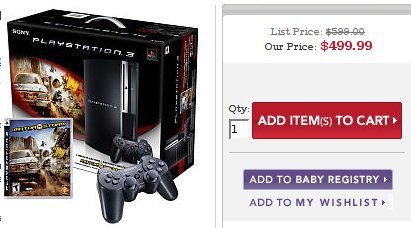
The implication is that Toys R Us is discounting the console further from the list price, but GS knew that the list price is now $499 no matter where you buy the console—hence, this was no discount at all. He decided to ask Toys R Us what was going on:
There was no option for simple pre-order questions or to report problems with the website…. So I navigate phone-tree hell and finally get somebody on the phone. They insisted that the list price was $599. I explained that the initial launch PS3 bundles were indeed listed at this price, but the item they mentioned was not $599. There was some discussion surrounding that the launch PS3 was an entirely different model and SKU- including a 60gb model (not 80) and didn’t include Motorstorm as indicated in this online listing. In fact, this sku was always $499. [see image at left. -Consumerist]
They went to the Sony store online and told me they searched on SonyStyle for “PS3” and again insisted that the list price was $599. I repeated the search on my end of the phone call and saw what they saw.
They then conceded there was a problem (finally) and said it would be looked into. I asked if they would honor selling me this PS3 for $100 off the list price as Toys R Us Dot Com showed they were selling it (the list price actually being $499 not $599 as listed) and they said they would not.
Note: Today we visited the Sony link and any mention of a price had been removed. Here is the original page as sent in by GS, taken earlier this week. He continues:
I am not sure this is illegal or unethical- as a consumer I was prepared to buy it for $399 if they would honor that price. I am still prepared to buy the 80gb motorstorm bundle for $399 if they would honor that price, but that is besides the point.
So- it is definitely illegal to indicate an inflated list-price in NY State and probably other areas. As I live in NY State and this product would be shipped to NY State. Toys R Us Dot Com markets in NY State and it would seem that this consumer protection applies. This could be an innocent mistake, but part of me thinks it would be reasonable for them to honor their posted discounted price in either proportion ($100 off of $599 is a discount of 16.66667 percent) or as a drop of $100 off off the $499 actual list. Either way I’d buy it..
What are your thoughts?
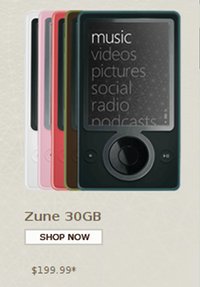
The next day, GS found a similar pricing issue on Toys R Us with a Zune:
I check Techbargains.com occasionally. At lunch i noticed a clearance sale over at Toys R Us dot com. I wondered if the list price issue was fixed on the PS3 so I clicked through techbargains and then clicked for items over $100 and found the 30gb Zune listed.. the list price is noted as $249.99 and then, below it- Our price: 199.99… I just checked on http://www.zune.net/en-us/products/compare.htm and found the 30gb is listed at $199.00. The price was dropped when the new Zune models were announced. Now what is really troubling is that this page is supposed to show things on a clearance sale! It says so at the top of the page.
Gizmo Sprocket makes an interesting point from a business liability perspective: if you list an inflated percentage of savings based on an out-of-date list price—which is what Apple does on its refurbished products—and a customer catches it, can he demand you honor that percentage discount on the real list price? If so, that’s reason enough to start being completely honest with list prices, “original prices,” and reductions.
As to the legality of it (we’re getting there, we just had to get through a lot of backstory first), here’s the actual law in New York City:
Rules of the City of New York –
Title 6
Department of Consumer Affairs§5-91 Reductions Based on Advertiser’s Own Price; “Formerly,” “Regularly,” “Reduced,” “Percent Off,” “Save,” and Similar Terms.
(a) Immediately preceding price. If an advertiser uses the words:
“percent off”
“formerly .., now …”
“reduced”
“reduced to”
“regularly…, now …”
“now only”
“save $ …”
“was …, now …,
“item now $ …”or any similar term implying a reduction from a prior price charged by the advertiser, the price to which the reduced offering price is being compared must be the advertiser’s bona fide selling price for that item or service unless the advertiser clearly discloses another basis of comparison or qualification.
(b) Intermediate reductions. If the term “originally,” or any similar term, is used in any advertisement, the price stated as the “original” price must be the advertiser’s bona fide selling price for the same article or service prior to intermediate reductions, and the price immediately prior to the current reduction must be disclosed, unless intermediate reductions are clearly indicated by the language used.
Example: “Originally $75; then $68; now $65”; “Earlier this year $75; now $65”; “Further reduced to $50.”
(c) Comparison not recent. If a claim is based on a past bona fide selling price of the advertiser prior to the recent, regular course of business, the advertiser must clearly disclose that fact.
Example: “Last year $40, now $20.”
That seems to be saying that, if you’re going to list original prices in order to accentuate the appeal of your discount, you have to show a clear trail of the item’s pricing history—sort of like how Filene’s Basement or Daffy’s lists an original price, a reduced price, and then the current sales price on their tags.
RELATED
“You Can’t Discount The Past, Apple”
(Photo: Getty)
Want more consumer news? Visit our parent organization, Consumer Reports, for the latest on scams, recalls, and other consumer issues.

