Former used car salesman Alan Slone grows a conscience and reveals one of the major strategies dealership use to screw you when buying a new car.
At the heart of it all is the “4-square,” a sheet of paper (sample above) divided into four boxes: your trade value, the purchase price, down payment, and monthly payment. This is supposed to help you and the dealership come to an agreement, but as you’ll see, it’s really more akin to three-card monte dealer’s deck of cards. Many, but not all, dealerships use this tool.
Here’s 5 tips to get you started, and then a very detailed breakdown of how the dealership manipulates buyers with the four-square.
1) GET YOUR FINANCING THROUGH THE CREDIT UNION BEFORE YOU EVEN STEP ON THE LOT.
Once a car salesman knows you don’t need financing, they’re more willing to be forward with you and knows they don’t have to work on the payments with you, because it won’t help. We’ll still try to beat whatever APR you’re getting at the bank and offer you payment deals, but forget them. You’ve got it worked out, and only need to know the price – bringing us to the next point.
2) DON’T HAGGLE OVER ANYTHING BUT THE PRICE.
This seems obvious to most of the readers of The Consumerist, but most people miss this – especially if they’re getting dealer financing.
3) DO YOUR HOMEWORK.
Know what the MSRP of the car is, know what your trade is worth. (Here’s a hint: take the NADA and subtract about $2K – used cars are appraised by books that aren’t published to the public, so it’s not blue book or NADA value. It’s called “black book” value; “black books” are published weekly by companies such as Manhiem Auto Auctions (http://www.manheim.com/), and these show the going price at the auction, that week, for your car. Basically, wholesale cost.)
4) LET THEM KNOW THAT YOU KNOW WHAT THEY ARE DOING.
If you read this article, you are already ahead of 99.9% of the people walking in. They’ll cut most of the bullshit with you if they know that you’re not going to fall for it.
5) UNDERSTAND THAT YOU ARE NOT GOING TO PAY COST FOR THE CAR, AND THE AMOUNT YOU PAY OVER COST WILL BE MORE THAN YOU THINK.
6) HERE’S HOW THE FOUR-SQUARE WORKS:
The “worksheet” (or four-square, as it’s called) is the first thing a person will see when they sit down to negotiate a car’s price. This sheet is used both in used and new car sales. When the interested party sits down, they’ve already driven the car, and have talked to the salesman about what they’re looking for. The salesman has had the trade evaluated, if there is one, and has gotten the customers something to drink to take the edge off.
After sitting everyone down, the salesperson starts filing out the four-square. A blank one looks something like this:
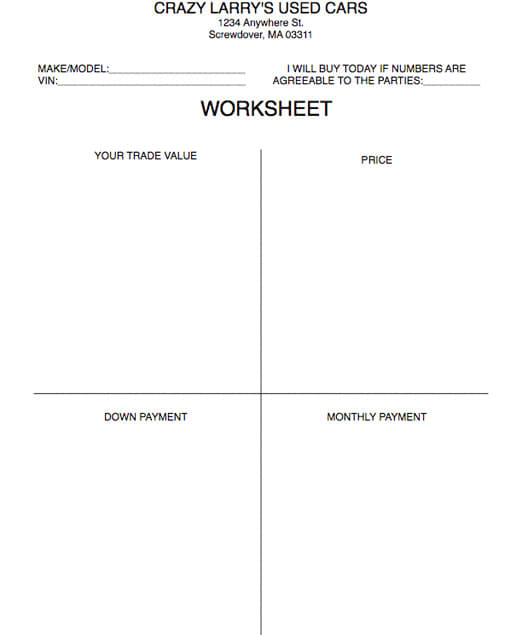
The salesman will only put down the make, model, VIN and customers information (not pictured). Then, the salesman will have the customer initial the part that says “I will buy today if numbers are agreeable to both parties.” If there’s any resistance (which normally there isn’t), the salesman simply says that its to make sure that the customer really is ready to drive the car off the lot today – IF they can get the numbers right. I never had anyone not sign the form who was actually willing to buy the car today. By doing this, you have shown your commitment to the manager in the tower (tower: back room, usually behind glass, where the salesman goes to confer with his manager.)
(A note about the tower: This is where the deal actually takes place. The salesman you are dealing with is NOT who you are negotiating with – the sales manager, who sits behind a desk (and is usually one of the scummiest people you’ll ever meet) is who’s actually going to be haggling with you. This will not happen in front of you, nor will you see what is actually happening. It’s a bit of theatre, this part.)
The salesman will then take the paper up to the tower, and when he returns, you’ll see something like this:
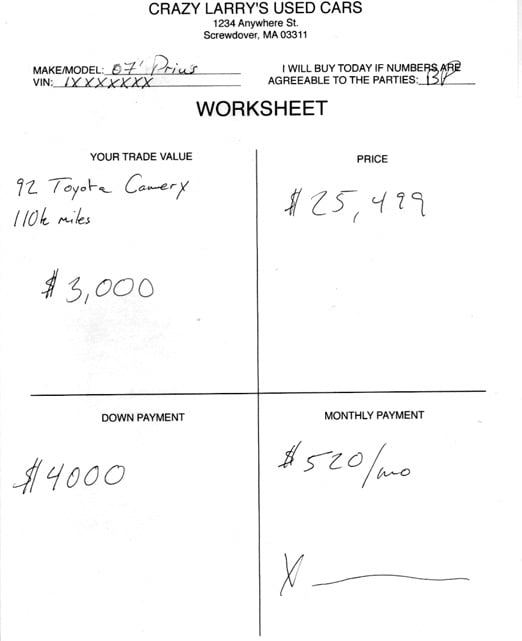
The salesman will start, very matter-of-fact, going over the numbers with you. First, he’ll start with the value of your trade.
The value of your trade, as listed, is $3000. You, expecting at least 5k for your beater, are unhappy with the number. That’s fine, the salesman says. We’ll get to that in a moment. He then goes on, very quickly, to just state the price of the car. Salespeople are instructed to move over these parts of the sheet VERY QUICKLY, as you’ll see in a moment.
Next, he arrives at the down payment square, which is easily double what you’d hoped to put down today on the nice new Prius you now want very badly. Lastly, he arrives at the monthly payment. “That payment is outrageous! I can’t afford that!” is what you’re probably thinking. All in all, these are pretty crap numbers from what you see.
THESE NUMBERS ARE MEANT TO INSULT YOU AND PUT YOU ON THE DEFENSIVE, ESPECIALLY THE LAST TWO. The idea here is that, unless you’re really observant, to get you less concerned about the overall price of the car and what your trade is worth (we’ll go into trade manipulation in a moment), and get you to the payment plans offered at the bottom. The salesman, who knows you are steamed, will keep on acting like nothing is wrong, and hand you a pen to sign by the X. This is done for two reasons – 1)You might be the biggest, dumbest sucker we’ve had today and actually agree to these terms (happened twice the three months I did this), or 2) You look like the aggressor when you say you won’t sign.
When you decide state that those numbers don’t work for you, the salesman will ask which numbers you have a problem with. Most people will go straight to the down payment, as that’s usually the part that most people gag on, followed closely by the trade in value. The salesman will then either talk about your trade (and proceed to downplay the car as much as they can – that’s usually pretty easy), or will go directly to the down payment. Very discreetly, the salesman will fold the four square so that the only figures you see when you’re talking are the down payment and monthly payment.
The salesman will then say “Well, what were you thinking about putting down today on the car?” You’ll respond something like 1500, 1000 or even less if you’re in a bind and NEED the car but are broke. The salesman will nod, and act as if he’s empathetic with your plight – those bastards up in the tower *are* asking too much from you! He’ll then cross out the down payment number and write in the number you’re looking for.
At this point, the salesman will say something to the effect of, “Well, we may be able to get that down payment done for you. But, as I’m sure you know, the less you put down today, the more you’ll have to pay off on the car – so this payment is likely to go up. What were you looking to pay on the car for payments?” You respond, “I didn’t plan on paying that much, must less more!” The salesman will pause, hoping that his last line will sink in a bit and you’ll either acquiesce to the current number or offer something higher.
If you don’t, and insist that you were only planning on paying $300 a month for the car, the salesman will say, “I don’t think I can do this, I really don’t. But, I tell you what; my manager is crazy today and hasn’t sold that many cars – he’s really under the gun from upper management to get some cars out today, and he might just do this. Tell you what – if I can get these numbers, would you buy the car right now?” You say, “Well, sure, I guess.” The salesman will say, “Okay, can you write me a check for the down payment so I can take it up there? They’re not usually willing to turn down someone if I show up with cash in hand!” (Real reason? People are really unwilling, for some reason, to ask for a check back later if negotiations start to break down.)
Most people, at this point, will write the check – if the salesman is good enough with the snow job, people will honestly think that they’re getting a good deal and that they need to do everything they can to get the manager to cave and sell them the car for next to nothing. The salesman will also get you to sign the form, by the X, saying that you’re agreeing to the new numbers, not the old. He’ll then put on his “wish me luck” face, and trudge up to the tower to haggle with his boss, the mean ol’ manager.
(A note about the X: There’s nothing legally binding here, BTW. You could sign your SSN, your blood type, and your name all on that line – but there’s nothing binding on either party to make that happen. It’s a precursor to the real deal with all the lovely paperwork in finance…but not the actual deal. However, the dealerships make you do this so you’ll think its official and leverage yourself into thinking you may have just bought a car.)
The salesman will return, with a huge grin on his face, and something like this:
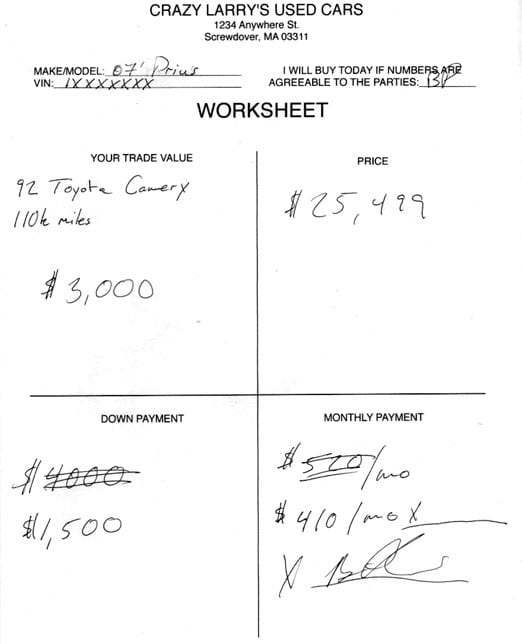
He’ll say, “Wow! He really is in a tough spot! He was willing to let this go for the down payment you wanted! But, like I was saying, he couldn’t really hit the payment you were looking for because he went down so far on the down payment, and he can let it go for this. (Motions towards new payment offer.) Would this work for you?” You will sit and look at the number, and wish you weren’t buying a car today but instead on vacation. You will either agree, and we’ll enter the final turn, or you’ll go another couple of rounds with them until they either meet you somewhere in the middle, or you start to walk out.
(Note about “walking out.” This doesn’t work if your offer is, truly, unrealistic. You need to do your homework before going in – this includes finding out how long the car has been on the lot [just driving by and seeing it for a couple of weeks is good ammo], what the going rate is for those cars, and above all else, securing your financing before you get there, so you’re more worried about the ACTUAL PRICE OF THE CAR instead of these bullshit terms.)
Now, lets say you’ve got a problem with the trade price, as well as the other figures (other than price.) The salesman (and manager) will probably agree to whatever price you want for your trade, within reason. So, assume the sticking point is that you want $5,000 for your trade – that’s fine, we’ll just say it’s going to be bought for $5000. We simply move around the price of the car to $2,000 more, and you’re in the clear. You don’t notice, we don’t say anything, and you feel happy. This is the way that dealerships do the whole “push pull or drag” sales where they’ll give you $5,000 for an engine block.
So, at this point, we’ll assume that you’ve gotten everything square and you’re ready to close the deal. Sometimes, if the manager feels especially nasty (or has gone a few rounds with you via the worksheet), they’ll come out of the tower and say “Folks, I’m (Douchey McDouchebag), the sales manager here. Congratulations! You’ve just bought a car! We were able to get the payments to $310 – I know you wanted $300, but that was the best we could do. That’s close enough, right?” They’ll nod their head (another psychological trick to get you to agree), and almost every time the person says “Yea, that’s fine!” The problem is, they didn’t realize that a $10 payment bump over a 5-year loan nets an extra $1k in profit for the dealership. It’s called “the $10 (or $15, or $20) close”, and I only saw it fail when a person was really, really exasperated with us. The deal ends, and you wake up in a year realizing that, somehow, you’re $6,000 upside down on your car, while the dealership is laughing all the way to the bank.
So, those are the major pitfalls associated with the four-square; it looks really unassuming on its face, but its designed to make you pay more, and not realize what’s going on. The manager, during negotiations, will write in BIG BIG letters, will turn over the sheet if he needs room, and will write over other things in order to make it as confusing and hard to deal with as possible in attempts to wear you down and make you sign.
The saying we used to have around the lot was “It’s like the Dallas Cowboys playing a Pee-wee Football team.” The average car salesman does this dance 4 times a day – you do it once every 3-5 years. They are better, and they will get you on some level. However, by doing stuff like this, you can control how much it happens.
Here’s what a finished four-square might look like:
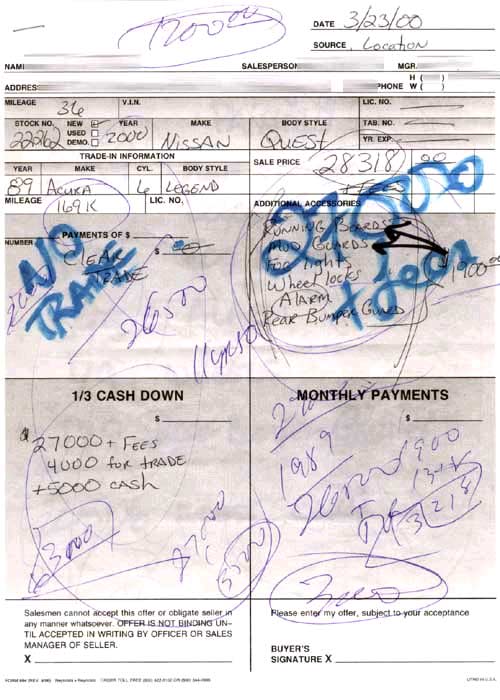
(Photo by Scott Jacobs, courtesy Edmunds)
What are your four-square horror stories? How did you “beat the box?” — BEN POPKEN


@sk07041: I have no idea about the tax or Dept of motor vehicle fee. At the dealership I work at we charge $399.50 for our Doc fee. This is something even I have to pay when buying a car. If someone complains too hard about it we will subtract it from the price (if room) however, we can’t remove the fee from our paperwork.
I know in Illinois they can’t charge any more than $59 for a doc fee. I guess some states have a limit and some do not.
I was going to say something along those lines but your comment was much better stated.
@Tonguetied: Damnit I was replying to castlecraver’s comment…
@Ayrton Senna:
If they can get to the payment I want, I don’t care if they’re robbing me blind on the rate; good for them.
Wow. And I thought the image of a customer walking in with “sucker” written on his forehead was just a metaphor.
@Salesman4U – my apologies, I was just using hypothetical numbers. I’m sure it’s not that much; I just no it’s a flat rate per car sold.
I tried to sell cars for a month or two way back in 1984. I worked at a Datsun dealership in West Palm. I must have been the worst salesman ever. I do remember that we were supposed to use this trick. It is exactly like it was over 20 years ago. We sold one station wagon to a nice family thousands of dollars more than it should have been, and I’ve always remembered and felt bad about it. What a ripoff the car business is.
I got my 06 VW GTI at invoice by walking in, sitting down, and telling the salesman I really wanted the car. I had done my homework and knew the invoice price, so when he came back with a horrible price because he thought I was a sucker I told him that I’d have to call my dad and ask him about it, since he knew a lot about buying cars.
The salesman said maybe they could do something better left and came back. Then I told him that if I just signed a deal without calling my old man that he’d never let me live it down.
I kept that cycle up until I paid invoice for my car. I encourage other young car buyers to use bizarre negotiation tactics.
I bought a car last August from a local dealership.
1) I refused to sign the “I agree to walk out with the car if we can agree on a price” line. It’s pretty simple, I just said, “I won’t sign anything until we work out the details.” Well, I signed it AFTER we agreed on the price, but by then the car was sold.
2) We didn’t talk about financing until after I agreed on a price.
3) After test driving the car and getting a ridiculously high price (“minus factory to dealer incentives!”), I went home and looked up the Edmunds and KBB values, subtracted the FtDI and $500 for my troubles.
4) When I took that number to the sales guy, he “took it to his general manager”, who said, “I couldn’t possibly sell it for less than my price + $250.” Whatever.
5) I still got screwed on the financing, since by the time I was in front of the loan officer, I’d been in the dealership for 5 hours! Get a loan before you step foot in the dealership, because that’s where I really got screwed.
I read this article on Friday and bought a used Yukon on Saturday. When the dealer pulled out the four square I knew just what to expect. Thanks Consumerist!
For whatever it’s worth-here’s my input: you vote with your dollars in this country, and every time someone gives in to the pressure sales and typical car dealer, it’s only reinforcing the cycle. First off, you should buy used and let someone else take that huge first depreciation hit, even if the car is a demo or only has 10k miles. Second, if you have to buy new, look for no-haggle dealers-they are out there. I bought a new subaru from van bortel in NY (I’m in TN) at an awesome price, and they offer no-haggle and low pricing on all their cars. For this reason, they are the now the largest subie dealer, and also get frequent death threats from other dealers, so I was told by the salesman. Aside from that, decide on what you want and the price and just start calling until someone bites. Once you enter the dealership, you’re at a disadvantage even if you’ve done your homework.
The Consumerist has a very enlightening article from a former used car salesman about the tricks that he used on customers, and how to recognize them.
One trick I’ve noticed here in Arizona is that they advertise vehicles on eBay for a certian price, then when you call they say, “sure, that car’s right here on the lot!”, but when you come down it’s always “just been sold by another salesman”, and they try to upsell you on another vehicle. Classic bait and switch. Has anyone else seen this eBay tactic here?
I bought my present car 10 years ago. At the time I didn’t have a car but I had the cash to buy one without financing of any kind. I’m a professional, but deliberately wore unstylish-looking clothes to the dealership. I then selected a brand-new but stripped-down Honda Civic, with air conditioning as the only option. I don’t recall discussing a financing plan with the salesman; if I was asked, I would have deferred the subject (because I’d intended to pay cash all along). Anyway, we signed the deal and then I brought out my checkbook. You should have seen his shock! He ushered me into the sales manager’s office, who stared at me sternly. He actually upbraided me! “Do you know that hardly anyone pays cash for their vehicle?” he said, in a righteous voice that suggested he had caught me with wrench and box cutter on the way to steal the cash register. I sat there, wondering what more he could say, all the while enjoying my victory. I’m saving up to do it again in a few years – but fortunately for me, Hondas are built to last a long time!
Ok….listen up all you car buyers!!! I am talking to all of you regardless of your situation down payment or credit.
Here is how you turn the tables on car dealers.
First….get your own financing before stepping foot on a car lot. Iknow I know everyone says this. here is the catch DO NOT TELL THE DEALERSHIP YOU HAVE FINANCING.
If you have cash DO NOT TELL THE DEALER THIS EITHER
Even if you have bad credit you can get financing before you step foot on to a lot.
Second…..Pick the car you want that fits into your budget based on sticker price.
Third…research bealer incentives…dealer cost….destination…do not be stupid and pick you car based on what you think the dealer pays…and having this number fit your budget…you will only frustrate your self and spoil your new car experience.
Fourth….. go on the lot and be stupid…find the car you want …… do not let on that you know anything about the car much less car buying…..EXCEPT price….. mention price…. mention price alot…. do not say a word about payments or interest……..you DO NOT CARE ABOUT payments or interest (bear with me here) after you pick your car and have peppered the coversation with price sensitive terminology….think about mentioning that you hope you can get financed…….you are not sure what your credit is and hope it doesnt cause problems cause you really like the car and hope they can finance you…… YOU HAVE NO IDEA WHAT YOUR CREDIT SCORE IS
NOW… haggle price price price…… four square closing is the most common… if you get this method focus on price… ignore payments and interest rates…..
Dealers will actually cut deals to below cost if they think they can make it up on some exorbitant interest rate….you can tap into kickback reserve advertising as well as destination fees if you play this well enough. Take the extended warranty… maximum and zero deductible……. mention this early on also… that you will be taking the extended warranty……
Now leave the dealership with all pertinant paperwork ……. and have your credit union or other previously arranged financing institution …or if you are paying cash…. pay off the car.
WHY YOU ASK…. because the bulk of money in a dealership is made on the back end… by service contracts and financing kickbacks….. financing institution offer dealers “BUY rates” for specific customers and delares kick this up to make more money…… the financing comapny and the warranty company come to the dealership and emand money back when you pay off the car with cash or your other fonanacing…… they knocked the deal down to bare minimum and sometimes loss to make what they think is more money on the back end…. and you walk away with a sweet deal…….
I’m a former used-car salesman… I used to tell girls I met “Trust me! I’m a used-car salesman.” It always was a good ice-breaker. To add to the article, if a customer had no cash/check I would ask for an unusual item… always with my back turned and my hand extended backwards. I would say, “Since you haven’t got a check, give me your necklace/hat/watch/etc.” to make the customer feel like they owned the car. You’d be surprised how hard it was for them to say no to me as I was about to go “fight” for them. On one occasion, I even got a shoe to secure the car.
In a former version of life I ran a business that worked closely with car dealerships- detailing used vehicles and providing the new car protection packages; rustproofing paint sealant and fabric protection. Many of the dealerships expected to charge our retail prices or higher while paying 25% or less for the services. Definately shop for these type items or accessories after the vehicle purchase is over. We developed friendships with some of the long-time salesmen, and they too would pull the trigger on a deal making as little as $75 on a new car. Used cars usually offered a better margin. My favorite story was of the many buyers who entered the showroom, breezed right past the salesmen, bragging about a trip to see their buddy, the dealership owner. Once the smoke cleared, the owner had bent them over the desk on a deal the salesmen never would have dreamed of, thanks buddy!
In partial response to Surrogate, ahjkgmd;
If you can get over the ‘stigma’ of a used car there can be a lot of great deals out there. Also line up your cash BEFORE you go shopping for a car. Often you can get a great rate on a line of credit if you are in good standing with your financial instituion. The reason for doing this is there usually isn’t any dealer incentives or fantastic interest rates for used vehicles.
Consider lease-backs or former fleet/rental cars. If you deal with a reputable dealer they will be mechanically fit, clean, detailed and most of the time smoke-free. I chose to buy a N.American mid-size car, not just out of patriotism but because you can get some really great deals on domestic vehicles if you look around as well as a WIDE SELECTION. I live in Canada ( up where the water freezes faster ) but this is similar all over. I have used this method a couple of times, most recently January of 2005 on a 2004 model that I had picked out. It was a cold Saturday and not a lot of customers and I had already been to a couple dealers already, read consumer reports and had an idea of the prices. The Ford dealer I chose had just gotten in three dozen assorted 2004 Taurus (sedans, wagons)and was slated to get in several more and the longer the cars sit there the more it costs them. They had them sorted into 3 or 4 price categories depending upon the mileage. The options supplied are certainly above base models and that usually includes power windows/driver seat/locks/AC/pedals/puddle lamps/leather steering/alloy wheels and other nice items. And you don’t have to negotiate for B.S. items such as the floor mats.
After a test drive I picked out 3 units with colors I liked. I had my eye on one sedan in category 1 (lowest kilometers)but concentrated the dealing on the two category 2 cars, got it down to a very nice lower price with a couple of the ‘back-and-forth’ trips to the manager, discussed financing, down payment and monthly payments through the dealer,etc. and then give the old ‘Ah, let me think about it, thanks for your time’ routine and got up out of my chair. The sales guy didn’t want to lose a potential sale and came back with the ‘What can we do to make you sign?’. I came back with ‘Well, tell you what, let me have that category 1 car for the price we just negotiated on the category 2 car and we’ve got a deal.
There was some humming’n'hawing and a trip to the manager but in the end they gave me the cat. 1 car for the cat. 2 negotiated price. They then proceeded to set out the monthly payment plan. I set out my cheque book and paid for it right there.
Yep, they were a bit taken back but what could they do?
In the end I picked up that one year old car that had only 8500km (5300 miles) on it with the balance of warranty for just over half of the new price.
Having owned both domestic and Pacific rim cars I can honestly say you get a bigger bang for your buck on a domestic vehicle. Dealers of foreign cars are not as apt to cut you any real deals on their products – and their cars have problems too. The money you will save in purchasing a recently used vehicle will more than put a grin on your face.
Here is another strategy. Anyone using the 4 square is likely a crook. Go in on a Saturday properly armed. Go through the whole process like you are having fun, and ready to buy a car. Start with a lesser car, and let the salesman “sell you up” to the nicer model you wanted anyway. What you want is for them to propose an outrageously fat deal.
You are playing the part of someone who is a great mark. Don’t let on that you know what deal you want, only that you were happy, but now are confused, and think the deal just doesn’t seem right. Say I don’t know, or nothing, a lot. Say little else unless it’s in the form of a question.
When the deal gets going, start dragging your feet, but keep the salesman with you answering questions, going over numbers, explaining everything again. Plan to be there for hours. You can easily save over a hundred an hour doing this.
The whole time he is with you, he is not selling cars. He will likely start to get frustrated, and his boss will be furious. They are likely to rudely get rid of you. Great, use that against them when you complain to the manufacturer and tell him about the deal they wanted. Then tell him you found out on the internet since leaving that the dealer is a scumbag, and was trying to make several thousand dollars on the deal. You now (this is part of the act )know what a fair price should be (About $500 less than you would actually do the deal for). Ask why they keep a dealer around who treats people like they treated you.
Sometimes, the original dealer will wise up before getting rid of you and offer you a deal you want (assuming its a fair deal), but if he acts rudely, then you get the manufacturer involved. They will likely help you get the deal with the original dealer, or a different one.
Enjoy.
Great site for car buying info.
I have worked many years in finance at a dealer.
I have to stress the fact that you need to do your homework before walking into a dealer. Once you agree to a selling price of the vehicle you need to be extremely careful of all the “extras” that they will try to add to your order in the finance office. Glass etching, Doc fees, dealer prep, pin stripe, tire & wheel warranty, paint sealant, and the list goes on and on. The dealer makes a huge profit on the “backend” products.
Want to save a couple of bucks? Refuse to pay the Doc Fee and glass etch fee. Doc fees($149 – $299)are treated as pure profit to the dealers bottom line. They are pre-printed on the orders to create the illusion they are mandatory.
Glass etching is typically applied to all vehicles on the lot and they will tell you they do this for insurance purposes and will be charging you $149 to transfer the policy to your name. Fact: glass etch costs from $0 – $5 per car for the labels placed on the car. The “etch registration” actually costs about $25 to the dealer but only once the customer signs and accepts it. Refuse to pay these fees or get up and start to walk out. Watch how fast the manager will try to negotiate them or remove them completely.
I know of a dealer that uses a special buyers order for their “Used” vehicles that has over $900 in dealer fees pre-printed on it. Dealers collect more than 90% of the fees they try to charge customers for.
the costco program is useless. You’re better off getting quotes from Edmunds (via an anonymous email (sneakemail.com)).
i eventually settled on a VW, the only dealer in the state on the costco program was 200 miles away from me. their financing partnership with capitol one was … *insulting* at best. almost double the incentivized rate for the same term.
ultimately, the internet sales option via email and going through the TMV price links on edmunds worked for us. They beat the TMV, and got pretty close to invoice. $550 over. Not bad, not great.
the finance guy was a piece of work; however. tried to take 1% extra on the note, hardball on their ‘armor’ and insurance.
I am a finance director at a large dealer and we do use the 4 square….HOWEVER it is not used in the direction stated in this article….not to say that isn’t used that way…it is..
Like any tool it is the intent of the user.
We actually use it to isolate the objections to make it easier for the customer to make an informed decision, whether payiong cash, going to their Credit Union or what ever….
We value every customer that comes in here, we are a larege dealer in a medium to small town, we value our reputation greatly….if we used it the way other dealers do or that is portrayed here we would cease to exist.
IF you look at it the way we do you would agree that seeing every part of the transaction broken down in fornt of you…DISCLOSED..if you will it helps the customer have input in the purchase unlike most other dealers that cram the 4 square process down your throat….yes it can be a leathal weapon for a dealer if done properly on the right customer….In a perfect world a customer is well informed in the pricing/invoice/ rebates etc….put that customer in front of a profession salesman/women w/ a proper 4 square everybody wins…a car is sold in a timely fashion and we have a completely satisfied customer and a salesperson who is not tied up for 3-4 hours trying to screw someone…the name of the game is volume….if we make a strong profit …GREAT..if we make a Dollar or TWO the is good as well….People need to be aware that the sale of the vehicle..mostly on the new purchase… is not what drives a new car dealer, it is the service dpt…
We make our money on certain vehicles certailnly not the ones that we have 40 of instock…more so on the ZO6 Vettes etc..
We are a good down home dealer that cherishes each customer….our owner is actually here everyday and is more thatn willing to sit down with you and get to know you…
We are the exception to the other SCUMBAGS out there..I hate that you all have to deal with the CHEESE HEADS that give us all bad names but as long as they are there it makes our job easier….because once you arrive here your defenses come down…BUying a car does not need to be Battle Royal nor does selling one….it should be easy and enjoyable….
As a costomer I am not afraid to be strong and inquisitive….nor should all of you…
A fair deal is where everyone wins…if it is one way then that would be masturbation…..either on my side of the desk or yours…keep your guards up until you feel comfortable with the dealer or the people you are dealing with.
“Now for the rest of the story” Being a car salesman, I’ve seen it all. Salesman and F&I that will slam dunk someone every chance they get.
I’ve been very fortunate in that I have a great repeat customer base, which I might add, I take care of them after the purchase. I pick their cars up for service work, if they need to leave their car in service I arrange to get them a loaner vehicle at no cost to my customer. I’ve even loaned customers special vehicles (like a 15 passenger van) for school or church trips. The list goes on and on (Service after the sale)
On the other hand, I’ve waited on many many customers who will make the most unscrupulous car salesman look like an alter boy. Most of the unknown customers I wait on are all the same. They want the dealership to give them top retail money for their trade and want the dealership to sell their car at a wholesale price.
NADA & Bluebook are only a guide in a perfect world as to used car values. This does not mean the dealer was able to trade for this amount. Many times they have to put more into a trade than ACV, then there could be service charges added because of undisclosed or undiscovered problems with the car after the trade.
So the beat goes on. The buyer doesn’t want the dealership to make any money and the dealership needs to make a profit to stay in business. I don’t quite understand why car buyers don’t think the salesman or dealership should make a profit.
A day in the life of a car salesman is no easy task. Try spending 12 hours a day tromping the concrete, moving cars around in the heat and cold, dealing with 9 out of 10 people that couldn’t buy a can of beans on credit and then the one that can buy beats you down to making nothing on the sale. Now this person may have gotten a pretty good deal but you can bet the salesman isn’t gonna bend over backwards to help the person who all but called you a crook from the get go and thought you don’t deserve to be compensated for all the time spent selling them a car at cost.
Look, car salesman know all about the old, “No, I don’t have a trade trick” “Just give me your bottom line on a straight sale” and then they want you to appraise their trade in. Cut the crap, if you got a trade, just say so! Tell the salesman you have a trade and to work the prices in “Real Money”. Now who’s trying to beat who? Car salesman have to be on the defense because, shhhhh, customers sometimes will tell you a lie.
All my repeat customers know I have to make money, they know I am going to give them a good deal, generally I will make $500 – $1000 gross profit on a vehicle, of which I get 25% and they have no problem with this. The benefits of “Service after the sale” are tremendous compared to “No service after the sale” for those who think the car salesman is a crook and doesn’t deserve to support his family.
And that’s all I got to say for now.
I’ve only seen four-squares twice in my life.
The first time, I was just 17, and my uncle, (an ex used-car salesman) went with me. He turned the “confusing overwriting” on it’s head… he took out a marker and wrote over everyone else’s notes what we would accept. It worked.
Years later, when presented with a four-square, I remembered this. By a twist of fate, I had a blue Sharpie in my pocket. I overmarked the foursquare with what I would accept… and it worked.
I still got taken, a bit. The car, which had a fabulous body and interior, had a blown head gasket, but the dealership had the wisdom to replace the oil and top off the water frequently, causing that to be overlooked by my mechanic.
Even with the replacement engine I bought, I drove the car for over a year, then sold it for a (tiny) net profit.
The man who bought it from me tried another used-car buying trick. He kept spreading larger and larger sums of cash in front of me (mostly in 20-dollar bills) I’d seen this trick before, and even used it. (I worked for a time in the Southeast in real estate developement. The same trick is used there. Grown men will melt and sell their souls for a briefcase full of 20-dollar bills, even when what they are getting is half of their asking price.) I just kept pointing at my “firm” price soaped on the windshield, and told him I’d seen much more cash than that before. He caved and payed my firm price.
@sk07041:
Call your local tag/lisence office and find out how they figure the money.
I bought a car just 3 months ago for $16000, paid $450 in taxes, $0 for my tag (Disabled Vet), and $60 for my annual tags. This was in AL, too.
I had to wrangle with them to get the formula they use to figure it, though, for the taxes.
it amazes me that strokes will go to a car lot and even start to negotiate. first off, the price is right on the sticker of all new cars. if this price is too much, you cant afford it, or move on to something you can afford. profit is not a bad word. do you morons go to wal mart and try to negotiate a price on a gallon of milk? or even worse, ask for the invoice? I am sure there are folks who try. what about when you go to mc donalds, do you tell them you don t want a drink, then ask for it later? there are a lot of smart consumers out there, do your homework, but dont stop on my lot 5 years before you are ready to purchase. bring your wife, dad, neighbor, etc… when you are getting these figures and be ready to do business. if you have to sell your dog first, or move your piano, before you buy, then do that first. dont waste anyones time if you are not a buyer. one last thing, BUYERS ARE LIARS.
I cannot tell how many times i have seen a salesman who could not make it in the business write an article on how to buy a car. it makes me sick.
If you want Kelly Blue Book for your trade in, sell it to Kelly, they just might write a check for it. lol
Does anyone know if buying from a Ford dealership using their X-Plan is really a legitimate way to avoid all the nonsense as described here? Supposedly if you can get an X-Plan pin number, you can get the vehicle for a significantly lower price than through haggling, no extra dealer fees are tacked on, and you are still eligible for any incentives that are in effect.
Any feedback from anyone in the know?
This four square is completely, in-accurate, and rediculous!!! The four square is basically designed to show payment based on money down, trade, terms, with warranty, gap insurance and any other additional options that the dealership has to offer, this is why when you get into the business office, generally they will use a menu to offer you options that are available.
This comment you wrote about arranging financing before you arrive is also stupid, what if the dealership can offer a better rate, should the consumer pay more for their car each month???? How about paying cash??? Is that smart? NO! when you pay cash for a car, you are dumping your positive cash flow into a depreciating asset, you are throwing your money out the window. What if you totaled your car? what if it got stolen? HOW MUCH money do you think the insurance company is going to give you????
Here is another reason why…….unless you have no existing debt, like a home, credit cards and you are as wealthy as Warren Buffett, you should drop your cash into your home firstly, because the cash applied to principal will SIGNIFICANTLY REDUCE YOUR INTEREST THAT YOU WOULD BE PAYING ON YOUR HOME. The interest you pay on a car is nominal compared to the interset you pay on your home. Check this out on BANKRATE.com….typically depending on the type of loan you have with your mortgage, using myself as an example, dropping 30k into my home will save me over 120k over the course of my 30 year fixed loan.
It really takes some common sense to figure these things out, but uneducated consumers who only look to “get over” on the dealers because the dealers are all just”scumbags”,and are just trying to screw everyone who walks through the door, end up screwing themselves over.
The guy who initiated this post is obviously not very seasoned in the car business, and must be some disgruntled employee that got fired for not showing up on time or something stupid, because he did not sell any cars, probably could’nt even close an open face sandwich, who thinks by posting this is helping out the consumer, when it is like the blind leading the blind!
“A poor mind is worse than an empty bank account”.
The last time I was shopping for a new car, I had a horrible experience with a salesman that tried this approach on me. I was looking at either a Honda Civic or a Mazda Miata. I had a friend wth me that was also looking for a Civic. I clled the dealership and told them what we were quoted for a Civic at another dealership and they assured me they could beat that deal- especially because there were 2 car sales involved. I had already looked at the Miata and was approved through Capital One for 5.75% APR for the Miata. When my friend and I went to the Honda dealership, they tried the whole 4 square thing on me. When I saw how high the payments were, I was flabbergasted and they treated me like I had the worst credit ever and they were doing me a favor. Then I looked at the manager’s desk and happened to see a list of banks they work with and Capital One was one of them. I told them that I was already approved through Capital One for less than half the APR they wanted to charge me (they quoted me 12% and I have decent credit). The whole ordeal ended up with the salesman and the manager literally backing me into a corner and yelling at me that they came up with the numbers that I asked for and that I had said I was committed to buying a vehicle that night, but I lied, etc. So I said, “well, why don’t you see what APR Capital One will give me since I’m already approved at a much lower rate for different car that they said was a piece of crap. If Capital One will approve me for a piece of crap, I’m sure they’ll go even lower since the Civic is such a good car according to you.” They refused and I left with my friend. He bought a Civic from another dealer. I decided I didn’t want to get the Miata so I bought a Toyota and they were awesome!
Thanks! I just got back from a Mazda dealership today. I walked out I was so disgusted. He pulled out the four square piece of paper and began trying to scam me immediately. I had no idea what the four sqaures meant. I just walked out because I could tell he was a cheesy scam artist, but now I know. Thanks again!
I disagree on one point in this article – dealers *will* negotiate from trade-in values garnered from websites like kbb.com and edmunds.com, but they might not like it.
They usually don’t like it because it usually decreases the profit they make by turning your trade around and selling it at an Auction value (typically about $2k higher) or better, if you have a nice trade, at Retail on their front line.
Best bet if you have the time and can avoid the scammers is to sell your car Private Party – you’ll make more money.
I agree, it’s at the finance office where they really try to screw you over. I find these days that the salesmen are pretty honest and upfront, but when you go into the finance office, all the numbers are changed. You have to really watch the guy and pay attention. I caught the guy several times writing down the wrong figure that had been agreed upon with the salesman, and the finance guy always gave this, “Hmmm, how that happen?” fake innocent reaction.
Hey Ben,
EJ
Nice overview.You really did a good job of making the process transparent though you sound a little bitter.
One factor you might have mentioned. Get your loan from a bank, but do not tell that to the salesperson. allow them to give up profit in other “squares” and make it all on finance. Sign all the contracts and then once signed-off by mgmt, use your own financing and enjoy a great deal.
I am not surprised at all the bad talk about dealers, but I have to say, we are not all bad! I am one of the F&I people, and I truly care about my customers. I always try to do right by my customers. I will always try to beat your rate quoted by your bank, and go over how your rates are compounded etc.
A lot of people think they are getting better rates at their own banks because the number sounds good, but don’t realize that the way the rate is compounded, you are actually paying a much higher amount when all is said and done. Like paying on your line of credit for instance, or an open loan etc.
Anyways, don’t throw us all into the same barrel! I am not one of the sleeze bags! I know they are out there, but we arent ALL bad apples!